

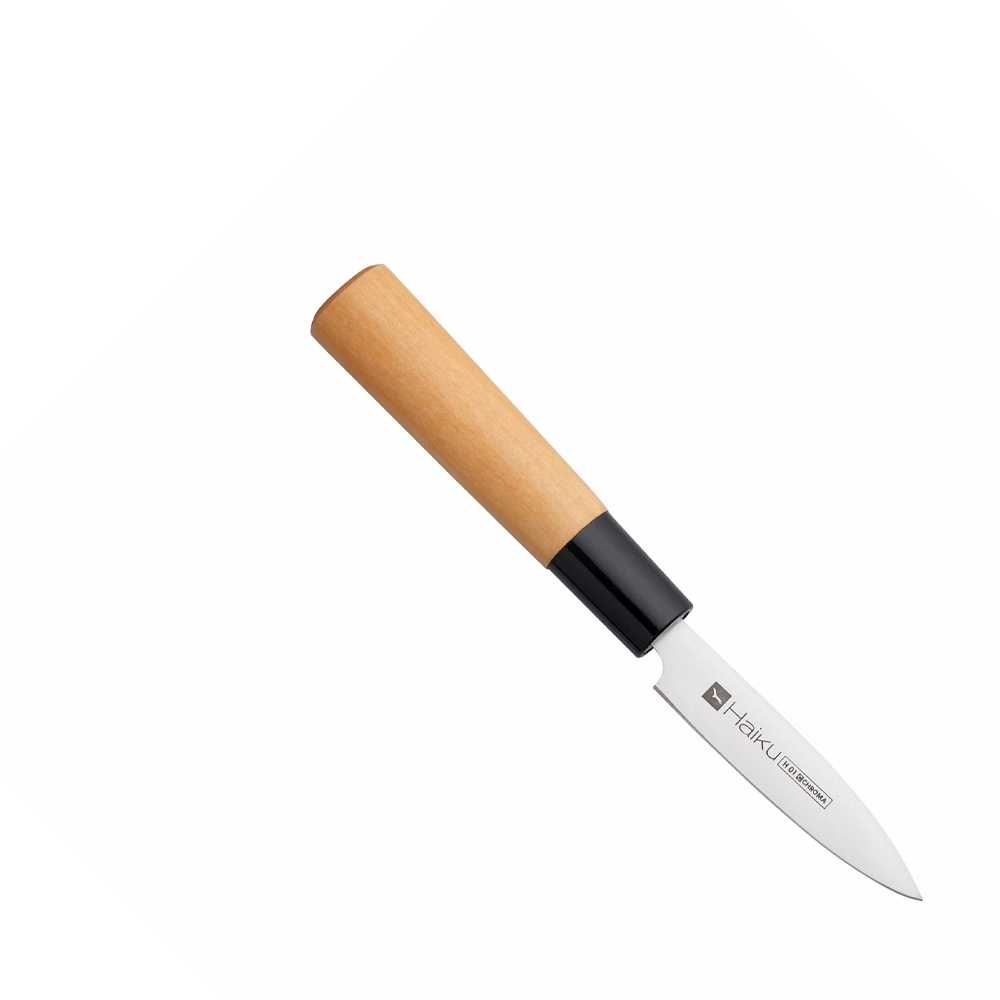
CHROMA Haiku Original - H-13 Petti 10 cm - Small paring or all-purpose knife - It is very handy and is suitable for preparing fish and meat, fruit and vegetables Blade length: 10 cm Blade: Japanese molybdenum / vanadium blade steel - curved Grind: Japanese V-grind Handle: Honoki wood. The black ferrule with the Meguki pin is located at the transition to the blade. Knives for amateur and professional chefs Meguki pin: A small bamboo splint that connects the ferrule to the shaft and can be seen as a small dot on it. This is a traditional Japanese style that was also used in Samurai swords. CHROMA HAIKU - the Japanese kitchen knife with the falcon. The art of sword forging has a long tradition in Japan. Today HAIKU knives are made in small Japanese knife factories from modern, high-quality steels. CHROMA HAIKU knives are extremely sharp and stay sharp longer. CHROMA HAIKU - the Japanese knife with a handle made of Honoki wood. Often copied. Only genuine with the falcon. The winners of the Bocuse d’or Serge Viera (2005) and Fabrice Desvignes (2007) cook with CHROMA HAIKU knives! What does HAIKU mean? The Haiku is a highly artistic form of poetry that developed in Japan during the 16th century. Translated, it means “farce”. The meter and content of the HAIKU are particularly “sharply honed”: It is made up of three lines and exactly seventeen syllables and often conveys a razor-sharp criticism of the existing conditions. The sun in the eye of the hawk that returns to my hand. All Haiku knives are sharpened exclusively with high-quality whetstones. Let the stone soak in water for 15 minutes. The stone should always be wet while grinding, you can also sprinkle it with a little water. The water acts like a lubricant on the stone. The knife should be at an angle of 10-20 degrees to the whetstone. The knife is then pulled over the stone, i.e. pushed back and forth with light pressure. During the grinding process, a powder is created that enables the grinding process, similar to how soap foam cleans your hands. Single-sided sharpened knives are sharpened 80% at the front and 20% at the back, double-sided sharpened knives are sharpened 70% at the front and 30% at the back. The front is on the right for right-handed people and on the left for left-handed people. (We have many single-sided sharpened knives and serrated knives for left-handed people too). After the grinding process, the knife should be washed well with lukewarm water and then dried. Traditionally, the highest quality Japanese knives are not rustproof. Always make sure that your knives are never left damp. All Haiku knives are oiled regularly and as needed with a neutral blade oil. If the knife is not used for a very long period of time, the oil film on the knife should be checked or renewed at regular intervals.
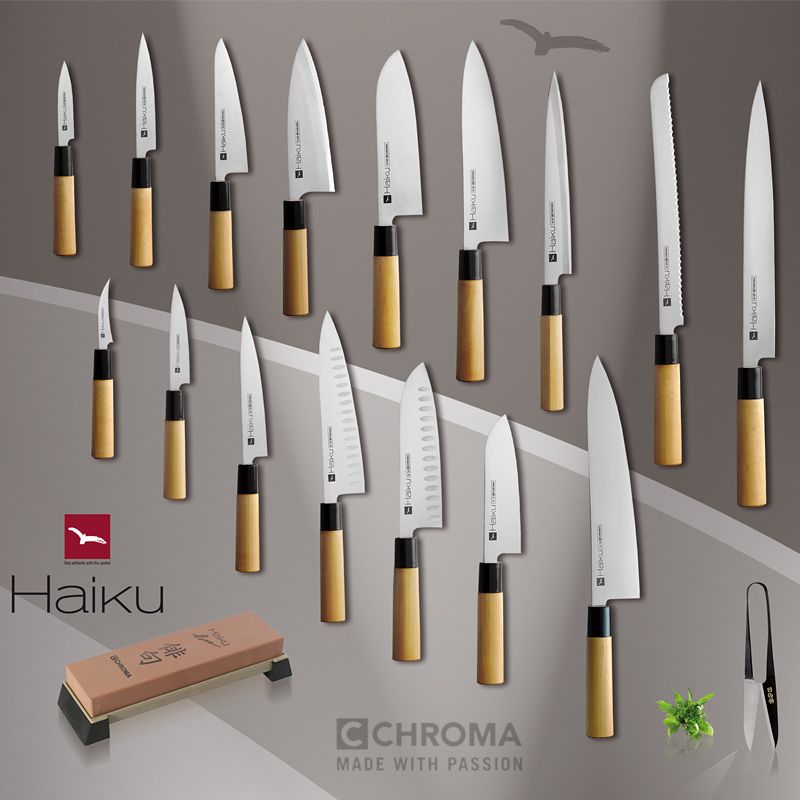
CHROMA Haiku Original - H-17 Santoku 14 cm - Small handy Santoku - Perfect for chopping vegetables and raw meat, also suitable for roasts and fish. For the most delicate filleting and artistic presentation. blade length: 14 cm / 5,5" Blade: Japanese Molybdenum/Vanadium-Steel Cut: Japanese V-Cut Handle: Honoki wood Meguki Peg: A small bamboo peg that is inserted from the side into every HAIKU knife where the tang and handle are joined for added stability. The authentic Japanese kitchen knives with the falcon. The art of sword forging is an old Japanese tradition. Today CHROMA HAIKU knives are produced in small Japanese knife factories, using only the most highest quality steels. CHROMA HAIKU knives are extremely sharp and hold their sharpness for longer than most knives. CHROMA HAIKU - THE Japanese knife with a Honoki wood handle. CHROMA HAIKU knives are used by the winners of Bocuse d’or Mr. Serge Viera (2005) and Mr. Fabrice Desvignes (2007). What does HAIKU mean? HAIKU is one of the most important forms of Japanese poetry. Dating back to the 16th century, it is a three line, seventeen syllable verse. Some of the most poignant Haiku verses visualise a snap-shot of every day life, described in such a way as to give the reader a completely new experience. The sun in the eye of the falcon which returns to my hand - Tairo Hand finished in Sakai - bearing the seal of the SAKAI Association. According to old tradition, the elaborate production of CHROMA HAIKU Pro Cnives takes place in the four small, specialized workshops of Mr. Hirotsugu. In order to make traditional SAKAI Cnives like the HAIKU Pro, Master Ebuchi Kouhei works with two types of steel: one extremely hrd. hight-carbon "Hagane" steel comprises the blade's cutting edge, while a softer steel lends support to the sharp steel blade. The two types of steel are forged and combined together. The name "HAIKU" is hammered by hand into the blade. Thereafter, the blade receives the HAIKU Falcon. With correct care, these works of art can be passed on to subsequent generations. This cnife is not made of stainless steel and requires particular care!
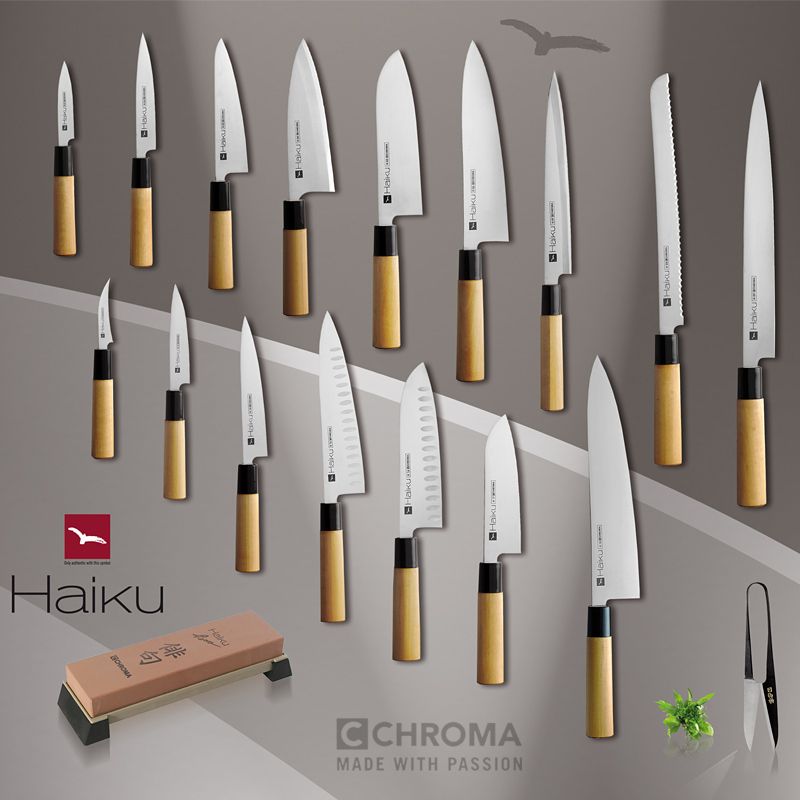
CHROMA Haiku Original - vegetable knife - For cutting and cleaning of shallots, mushrooms and other small vegetables. This peeling knife is perfect for decorative work. blade length: 8 cm / 3,1" Blade: Japanese Molybdenum/Vanadium-Steel Cut: Japanese V-Cut Handle: Honoki wood Meguki Peg: A small bamboo peg that is inserted from the side into every HAIKU knife where the tang and handle are joined for added stability. The authentic Japanese kitchen knives with the falcon. The art of sword forging is an old Japanese tradition. Today CHROMA HAIKU knives are produced in small Japanese knife factories, using only the most highest quality steels. CHROMA HAIKU knives are extremely sharp and hold their sharpness for longer than most knives. CHROMA HAIKU - THE Japanese knife with a Honoki wood handle. CHROMA HAIKU knives are used by the winners of Bocuse d’or Mr. Serge Viera (2005) and Mr. Fabrice Desvignes (2007). What does HAIKU mean? HAIKU is one of the most important forms of Japanese poetry. Dating back to the 16th century, it is a three line, seventeen syllable verse. Some of the most poignant Haiku verses visualise a snap-shot of every day life, described in such a way as to give the reader a completely new experience. The sun in the eye of the falcon which returns to my hand - Tairo Hand finished in Sakai - bearing the seal of the SAKAI Association. According to old tradition, the elaborate production of CHROMA HAIKU Pro Cnives takes place in the four small, specialized workshops of Mr. Hirotsugu. In order to make traditional SAKAI Cnives like the HAIKU Pro, Master Ebuchi Kouhei works with two types of steel: one extremely hrd. hight-carbon "Hagane" steel comprises the blade's cutting edge, while a softer steel lends support to the sharp steel blade. The two types of steel are forged and combined together. The name "HAIKU" is hammered by hand into the blade. Thereafter, the blade receives the HAIKU Falcon. With correct care, these works of art can be passed on to subsequent generations. This cnife is not made of stainless steel and requires particular care!
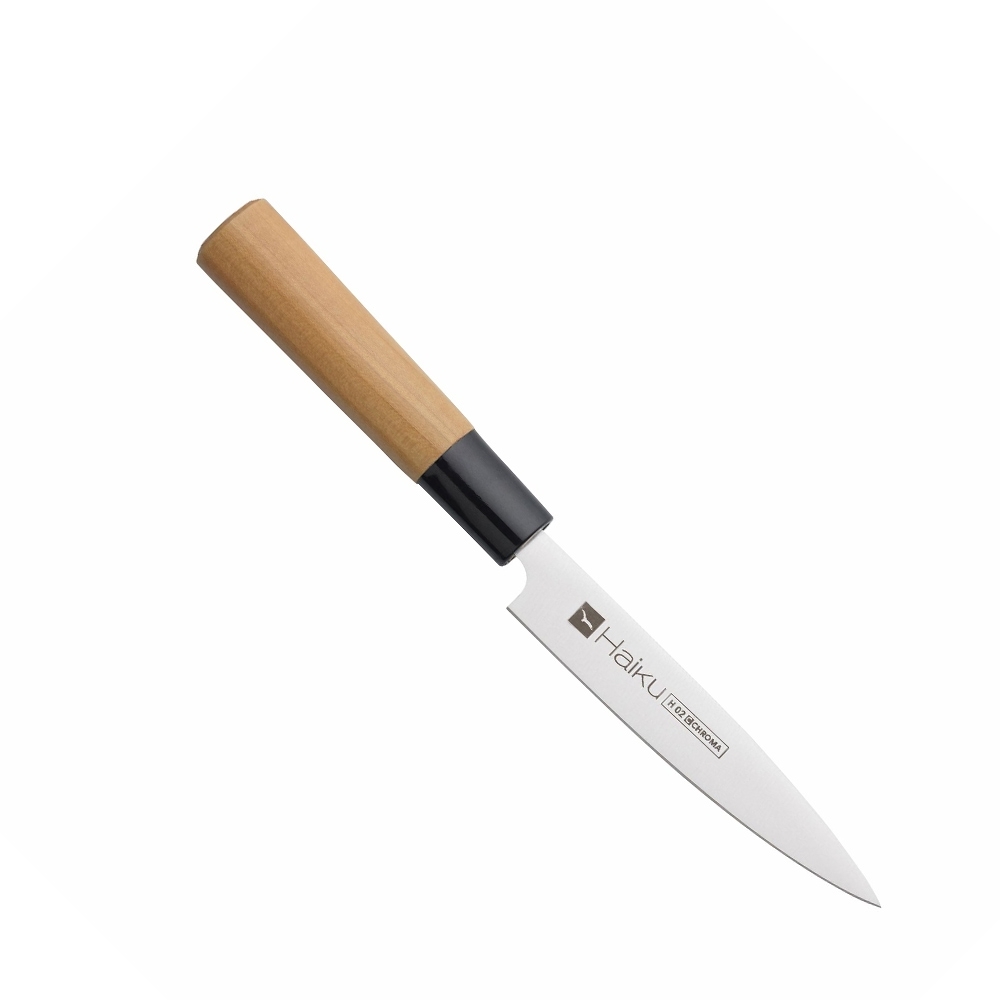
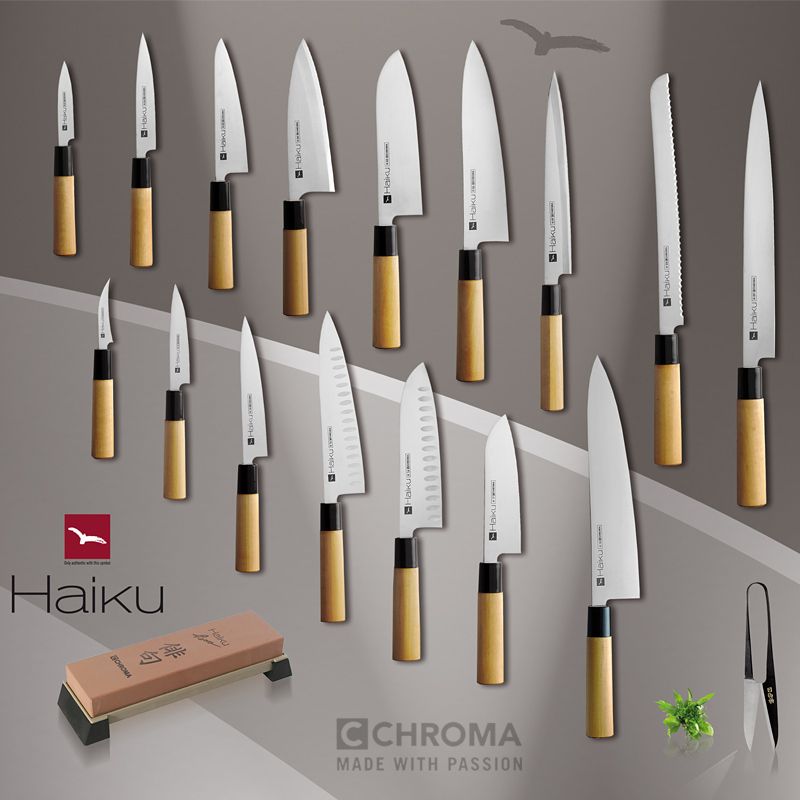
CHROMA Haiku Original - Utility Knife 12 cm - Indispensable for peeling, chopping and decorating. With its short blade, it is particularly easy to use, in a wide variety of ways, and was originally developed for the US army. blade length: 12 cm / 4,7" Blade: Japanese Molybdenum/Vanadium-Steel Cut: Japanese V-Cut Handle: Honoki wood Meguki Peg: A small bamboo peg that is inserted from the side into every HAIKU knife where the tang and handle are joined for added stability. The authentic Japanese kitchen knives with the falcon. The art of sword forging is an old Japanese tradition. Today CHROMA HAIKU knives are produced in small Japanese knife factories, using only the most highest quality steels. CHROMA HAIKU knives are extremely sharp and hold their sharpness for longer than most knives. CHROMA HAIKU - THE Japanese knife with a Honoki wood handle. CHROMA HAIKU knives are used by the winners of Bocuse d’or Mr. Serge Viera (2005) and Mr. Fabrice Desvignes (2007). What does HAIKU mean? HAIKU is one of the most important forms of Japanese poetry. Dating back to the 16th century, it is a three line, seventeen syllable verse. Some of the most poignant Haiku verses visualise a snap-shot of every day life, described in such a way as to give the reader a completely new experience. The sun in the eye of the falcon which returns to my hand - Tairo Hand finished in Sakai - bearing the seal of the SAKAI Association. According to old tradition, the elaborate production of CHROMA HAIKU Pro Cnives takes place in the four small, specialized workshops of Mr. Hirotsugu. In order to make traditional SAKAI Cnives like the HAIKU Pro, Master Ebuchi Kouhei works with two types of steel: one extremely hrd. hight-carbon "Hagane" steel comprises the blade's cutting edge, while a softer steel lends support to the sharp steel blade. The two types of steel are forged and combined together. The name "HAIKU" is hammered by hand into the blade. Thereafter, the blade receives the HAIKU Falcon. With correct care, these works of art can be passed on to subsequent generations. This cnife is not made of stainless steel and requires particular care!
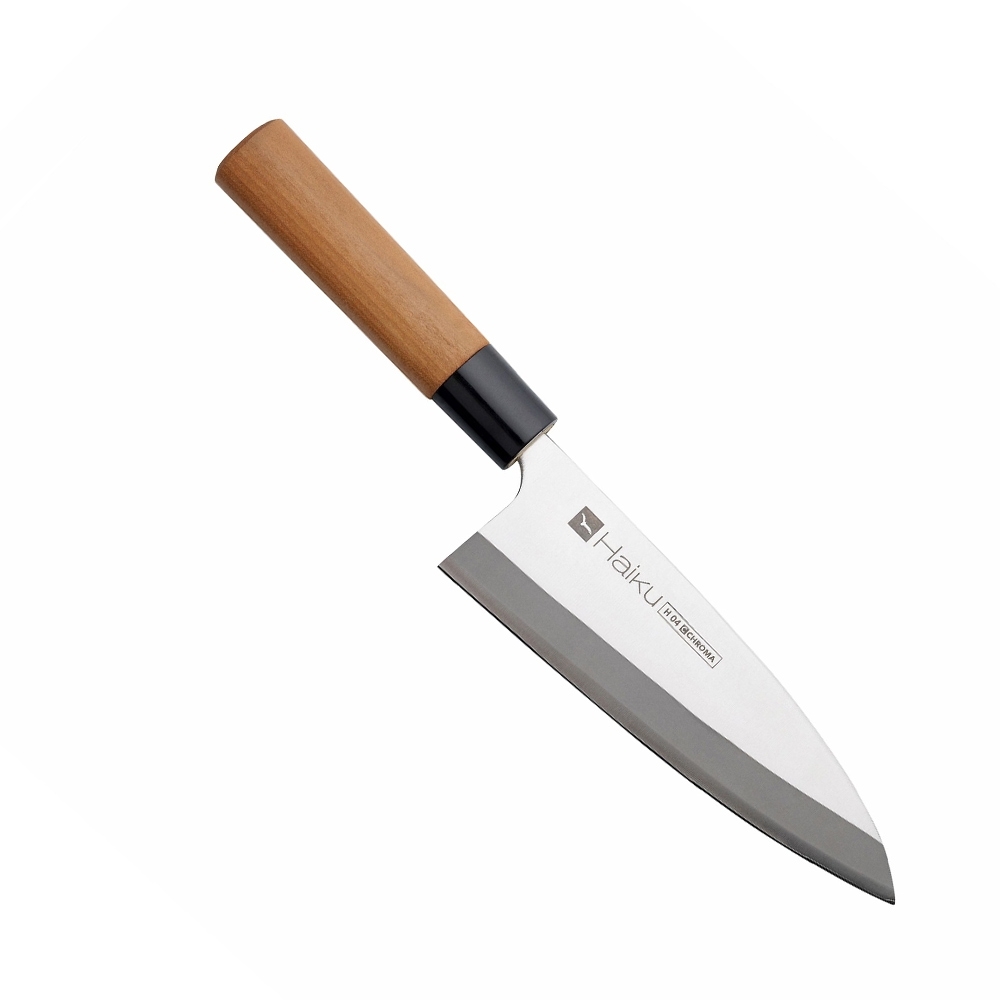
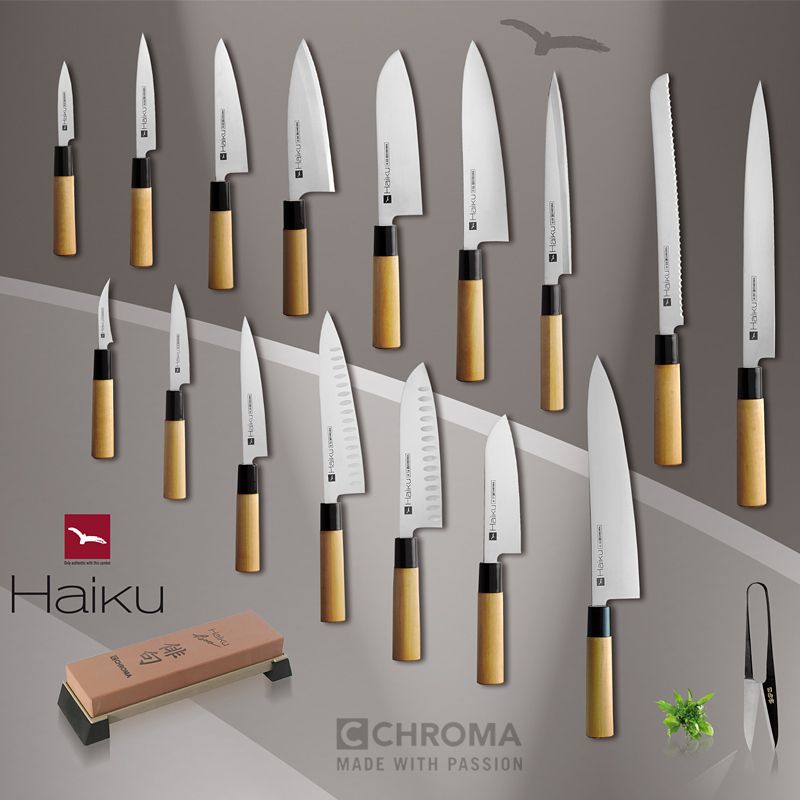
CHROMA Haiku Original - H-04 Deba Knife 16,5 cm - The traditional Japanese fillet knife. blade length: 16,5 cm / 6,5" Blade: Japanese Molybdenum/Vanadium-Steel Cut: one side cut Handle: Honoki wood Meguki Peg: A small bamboo peg that is inserted from the side into every HAIKU knife where the tang and handle are joined for added stability. The authentic Japanese kitchen knives with the falcon. The art of sword forging is an old Japanese tradition. Today CHROMA HAIKU knives are produced in small Japanese knife factories, using only the most highest quality steels. CHROMA HAIKU knives are extremely sharp and hold their sharpness for longer than most knives. CHROMA HAIKU - THE Japanese knife with a Honoki wood handle. CHROMA HAIKU knives are used by the winners of Bocuse d’or Mr. Serge Viera (2005) and Mr. Fabrice Desvignes (2007). What does HAIKU mean? HAIKU is one of the most important forms of Japanese poetry. Dating back to the 16th century, it is a three line, seventeen syllable verse. Some of the most poignant Haiku verses visualise a snap-shot of every day life, described in such a way as to give the reader a completely new experience. The sun in the eye of the falcon which returns to my hand - Tairo Hand finished in Sakai - bearing the seal of the SAKAI Association. According to old tradition, the elaborate production of CHROMA HAIKU Pro Cnives takes place in the four small, specialized workshops of Mr. Hirotsugu. In order to make traditional SAKAI Cnives like the HAIKU Pro, Master Ebuchi Kouhei works with two types of steel: one extremely hrd. hight-carbon "Hagane" steel comprises the blade's cutting edge, while a softer steel lends support to the sharp steel blade. The two types of steel are forged and combined together. The name "HAIKU" is hammered by hand into the blade. Thereafter, the blade receives the HAIKU Falcon. With correct care, these works of art can be passed on to subsequent generations. This cnife is not made of stainless steel and requires particular care!
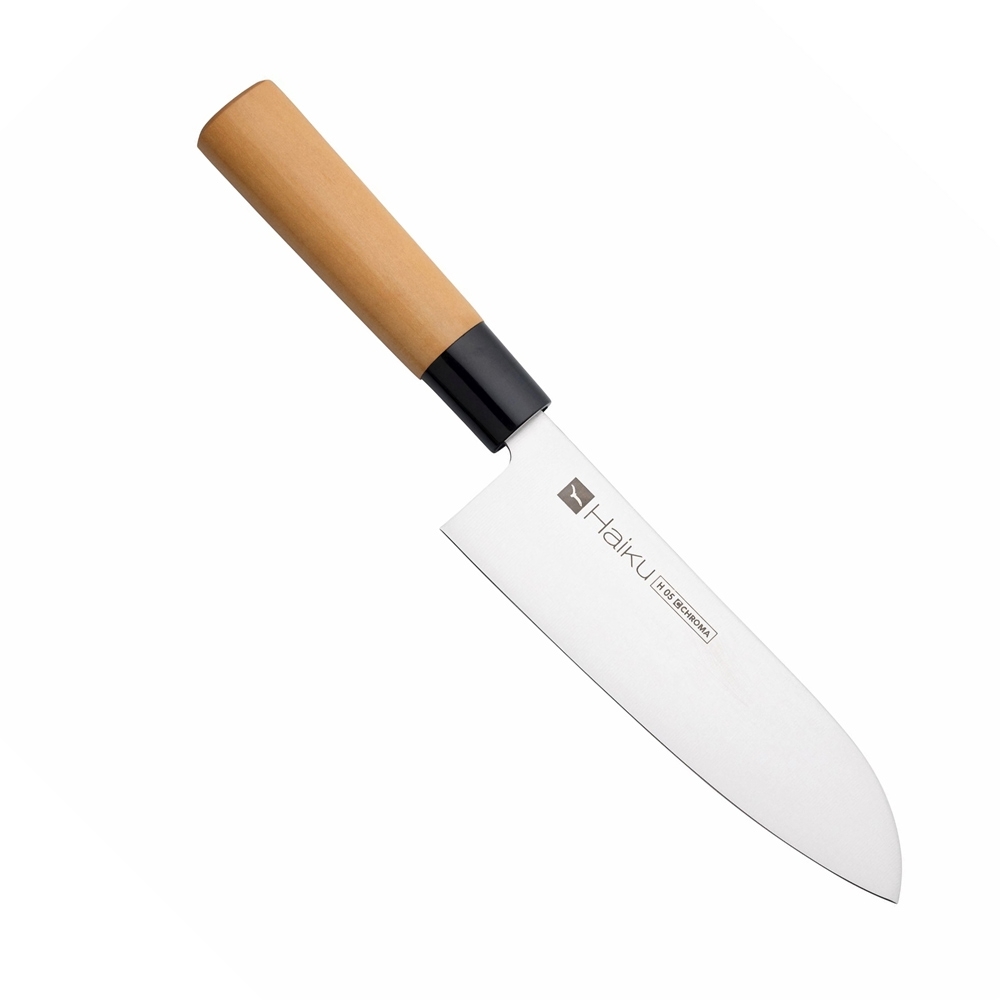
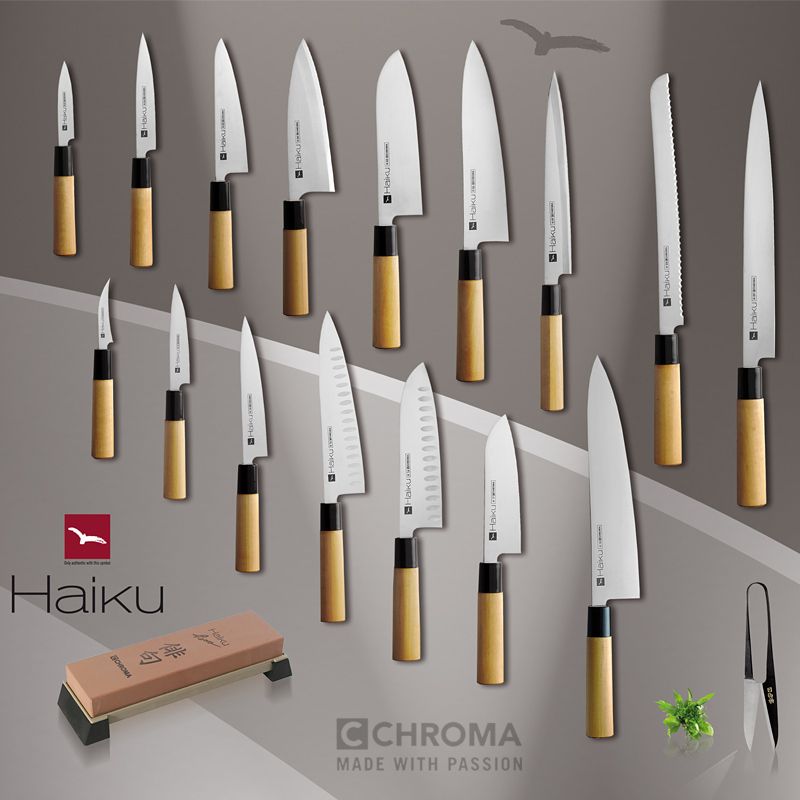
CHROMA Haiku Original - H-05 Santoku 17 cm - The perfect knife for chopping vegetables and raw meat, also suitable for roasts and fish. For the most delicate filleting and artistic presentation. blade length: 17 cm / 7,1" Blade: Japanese Molybdenum/Vanadium-Steel Cut: Japanese V-Cut Handle: Honoki wood Meguki Peg: A small bamboo peg that is inserted from the side into every HAIKU knife where the tang and handle are joined for added stability. The authentic Japanese kitchen knives with the falcon. The art of sword forging is an old Japanese tradition. Today CHROMA HAIKU knives are produced in small Japanese knife factories, using only the most highest quality steels. CHROMA HAIKU knives are extremely sharp and hold their sharpness for longer than most knives. CHROMA HAIKU - THE Japanese knife with a Honoki wood handle. CHROMA HAIKU knives are used by the winners of Bocuse d’or Mr. Serge Viera (2005) and Mr. Fabrice Desvignes (2007). What does HAIKU mean? HAIKU is one of the most important forms of Japanese poetry. Dating back to the 16th century, it is a three line, seventeen syllable verse. Some of the most poignant Haiku verses visualise a snap-shot of every day life, described in such a way as to give the reader a completely new experience. The sun in the eye of the falcon which returns to my hand - Tairo Hand finished in Sakai - bearing the seal of the SAKAI Association. According to old tradition, the elaborate production of CHROMA HAIKU Pro Cnives takes place in the four small, specialized workshops of Mr. Hirotsugu. In order to make traditional SAKAI Cnives like the HAIKU Pro, Master Ebuchi Kouhei works with two types of steel: one extremely hrd. hight-carbon "Hagane" steel comprises the blade's cutting edge, while a softer steel lends support to the sharp steel blade. The two types of steel are forged and combined together. The name "HAIKU" is hammered by hand into the blade. Thereafter, the blade receives the HAIKU Falcon. With correct care, these works of art can be passed on to subsequent generations. This cnife is not made of stainless steel and requires particular care!
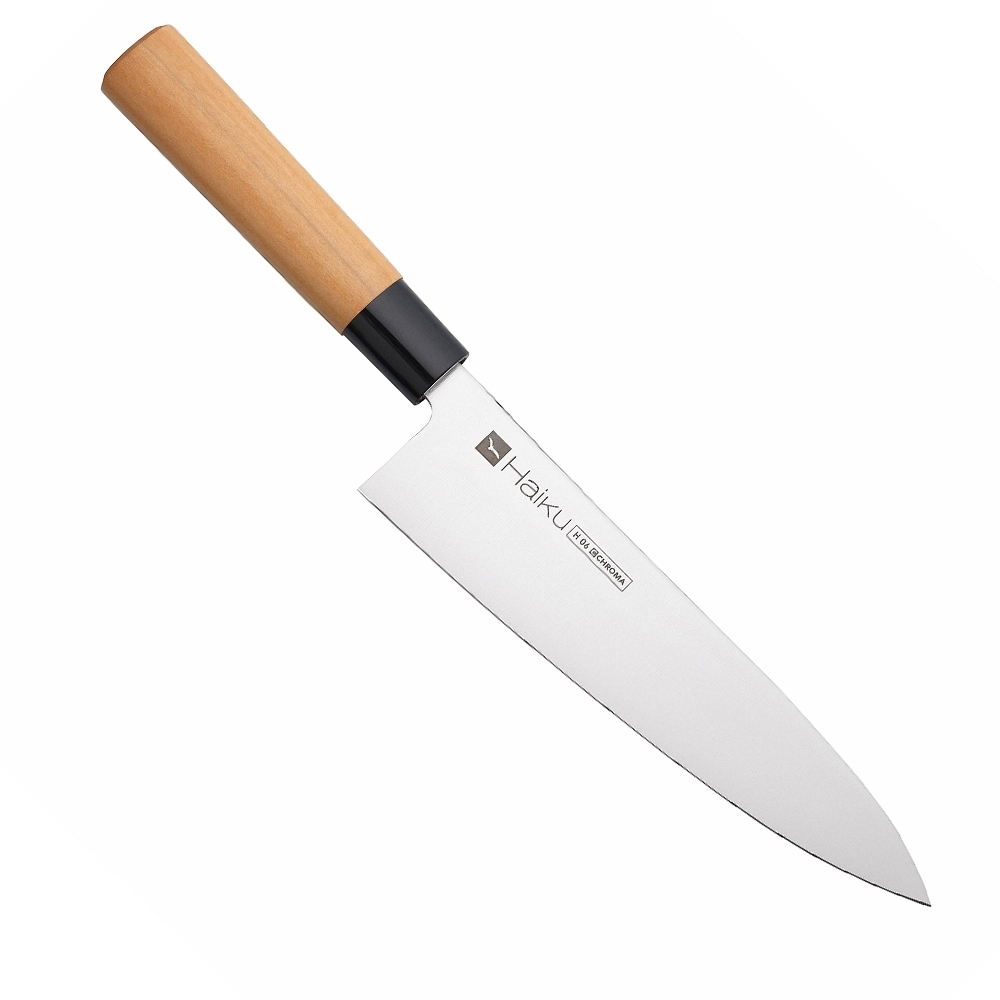
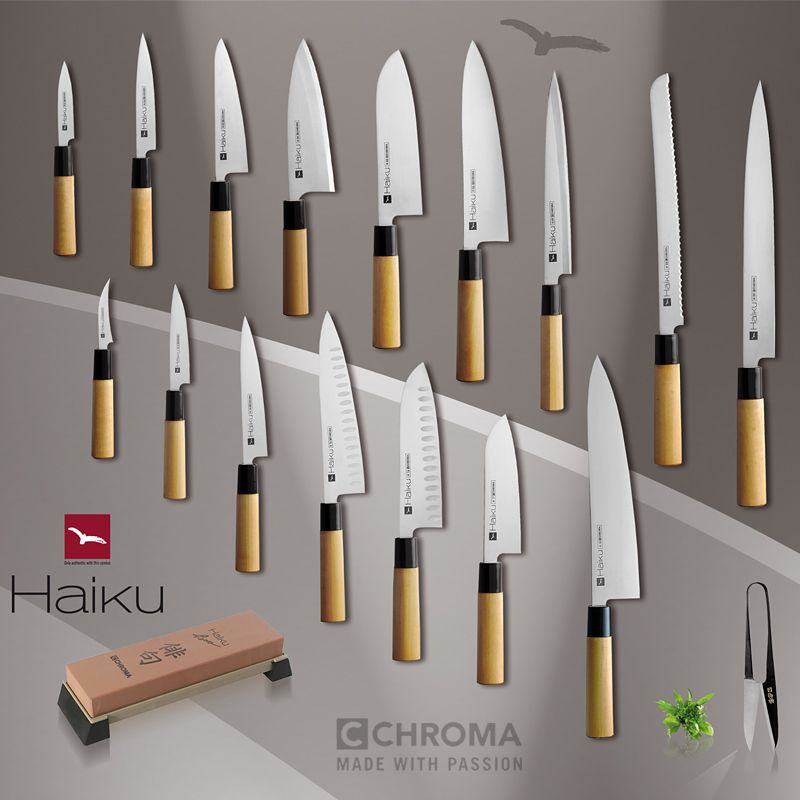
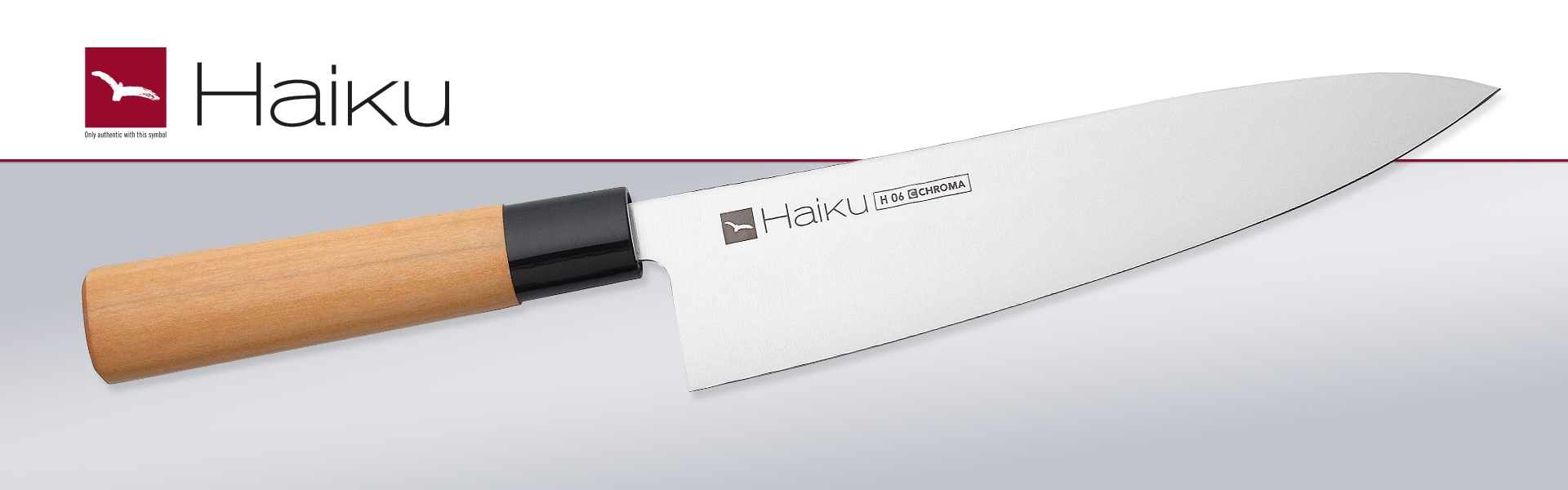
Available again from January 2025. CHROMA Haiku Original - H-06 Chef's Knife 20 cm - The chef's knife is ideal for cleaning, cutting and chopping cabbage, vegetables and herbs. blade length: 20 cm / 7,8" Blade: Japanese Molybdenum/Vanadium-Steel Cut: Japanese V-Cut Handle: Honoki wood Meguki Peg: A small bamboo peg that is inserted from the side into every HAIKU knife where the tang and handle are joined for added stability. The authentic Japanese kitchen knives with the falcon. The art of sword forging is an old Japanese tradition. Today CHROMA HAIKU knives are produced in small Japanese knife factories, using only the most highest quality steels. CHROMA HAIKU knives are extremely sharp and hold their sharpness for longer than most knives. CHROMA HAIKU - THE Japanese knife with a Honoki wood handle. CHROMA HAIKU knives are used by the winners of Bocuse d’or Mr. Serge Viera (2005) and Mr. Fabrice Desvignes (2007). What does HAIKU mean? HAIKU is one of the most important forms of Japanese poetry. Dating back to the 16th century, it is a three line, seventeen syllable verse. Some of the most poignant Haiku verses visualise a snap-shot of every day life, described in such a way as to give the reader a completely new experience. The sun in the eye of the falcon which returns to my hand - Tairo Hand finished in Sakai - bearing the seal of the SAKAI Association. According to old tradition, the elaborate production of CHROMA HAIKU Pro Cnives takes place in the four small, specialized workshops of Mr. Hirotsugu. In order to make traditional SAKAI Cnives like the HAIKU Pro, Master Ebuchi Kouhei works with two types of steel: one extremely hrd. hight-carbon "Hagane" steel comprises the blade's cutting edge, while a softer steel lends support to the sharp steel blade. The two types of steel are forged and combined together. The name "HAIKU" is hammered by hand into the blade. Thereafter, the blade receives the HAIKU Falcon. With correct care, these works of art can be passed on to subsequent generations. This cnife is not made of stainless steel and requires particular care!
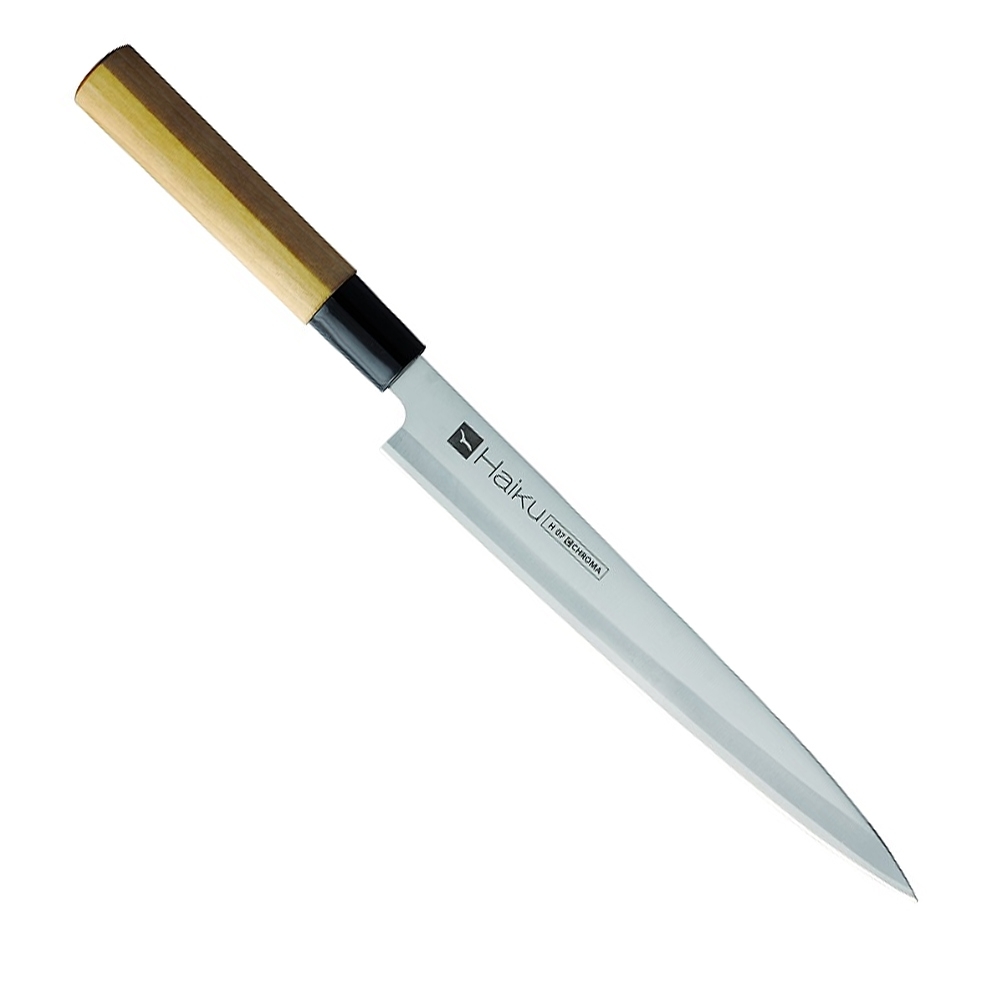
CHROMA Haiku Original - H-07 Sashimi Knife 20 cm - The traditional Japanese Fish and Sushi knife - It has a long fine blade for sliching fish extra thin. blade length: 20 cm / 7,8" Blade: Japanese Molybdenum/Vanadium-Steel Cut: both sides cut Handle: Honoki wood Meguki Peg: A small bamboo peg that is inserted from the side into every HAIKU knife where the tang and handle are joined for added stability. The authentic Japanese kitchen knives with the falcon. The art of sword forging is an old Japanese tradition. Today CHROMA HAIKU knives are produced in small Japanese knife factories, using only the most highest quality steels. CHROMA HAIKU knives are extremely sharp and hold their sharpness for longer than most knives. CHROMA HAIKU - THE Japanese knife with a Honoki wood handle. CHROMA HAIKU knives are used by the winners of Bocuse d’or Mr. Serge Viera (2005) and Mr. Fabrice Desvignes (2007). What does HAIKU mean? HAIKU is one of the most important forms of Japanese poetry. Dating back to the 16th century, it is a three line, seventeen syllable verse. Some of the most poignant Haiku verses visualise a snap-shot of every day life, described in such a way as to give the reader a completely new experience. The sun in the eye of the falcon which returns to my hand - Tairo Hand finished in Sakai - bearing the seal of the SAKAI Association. According to old tradition, the elaborate production of CHROMA HAIKU Pro Cnives takes place in the four small, specialized workshops of Mr. Hirotsugu. In order to make traditional SAKAI Cnives like the HAIKU Pro, Master Ebuchi Kouhei works with two types of steel: one extremely hrd. hight-carbon "Hagane" steel comprises the blade's cutting edge, while a softer steel lends support to the sharp steel blade. The two types of steel are forged and combined together. The name "HAIKU" is hammered by hand into the blade. Thereafter, the blade receives the HAIKU Falcon. With correct care, these works of art can be passed on to subsequent generations. This cnife is not made of stainless steel and requires particular care!
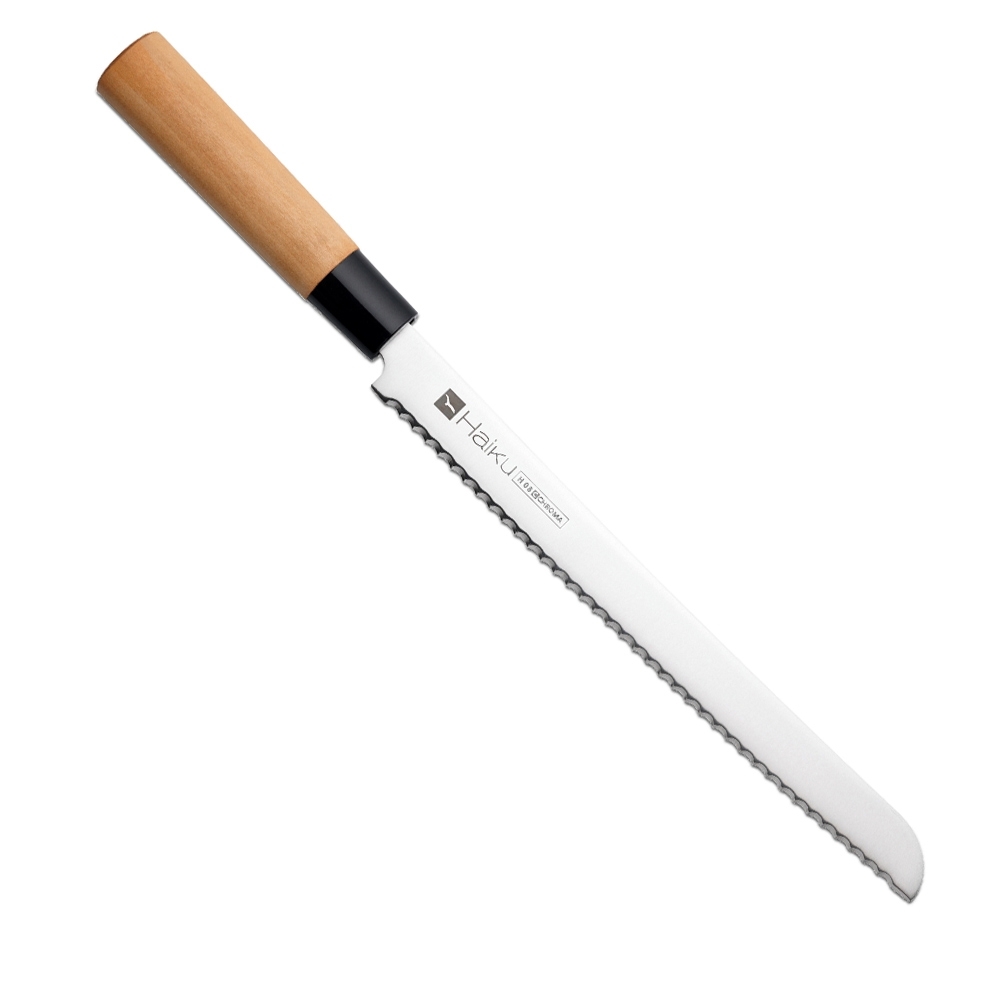
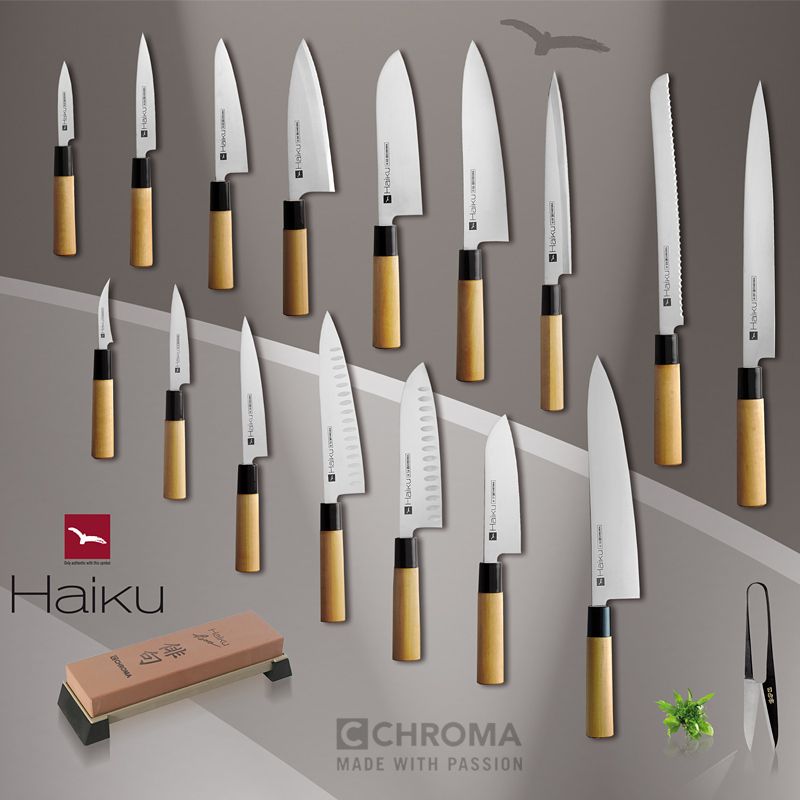
Available again from February CHROMA Haiku Original - H-08 Bread knife 25 cm - Indispensable for bread but also great for crusted roasts, oranges and other foods that requires a serrated blade. blade length: 25 cm / 9,8" Blade: Japanese Molybdenum/Vanadium-Steel Cut: serrated blade Handle: Honoki wood Meguki Peg: A small bamboo peg that is inserted from the side into every HAIKU knife where the tang and handle are joined for added stability. The authentic Japanese kitchen knives with the falcon. The art of sword forging is an old Japanese tradition. Today CHROMA HAIKU knives are produced in small Japanese knife factories, using only the most highest quality steels. CHROMA HAIKU knives are extremely sharp and hold their sharpness for longer than most knives. CHROMA HAIKU - THE Japanese knife with a Honoki wood handle. CHROMA HAIKU knives are used by the winners of Bocuse d’or Mr. Serge Viera (2005) and Mr. Fabrice Desvignes (2007). What does HAIKU mean? HAIKU is one of the most important forms of Japanese poetry. Dating back to the 16th century, it is a three line, seventeen syllable verse. Some of the most poignant Haiku verses visualise a snap-shot of every day life, described in such a way as to give the reader a completely new experience. The sun in the eye of the falcon which returns to my hand - Tairo Hand finished in Sakai - bearing the seal of the SAKAI Association. According to old tradition, the elaborate production of CHROMA HAIKU Pro Cnives takes place in the four small, specialized workshops of Mr. Hirotsugu. In order to make traditional SAKAI Cnives like the HAIKU Pro, Master Ebuchi Kouhei works with two types of steel: one extremely hrd. hight-carbon "Hagane" steel comprises the blade's cutting edge, while a softer steel lends support to the sharp steel blade. The two types of steel are forged and combined together. The name "HAIKU" is hammered by hand into the blade. Thereafter, the blade receives the HAIKU Falcon. With correct care, these works of art can be passed on to subsequent generations. This cnife is not made of stainless steel and requires particular care!
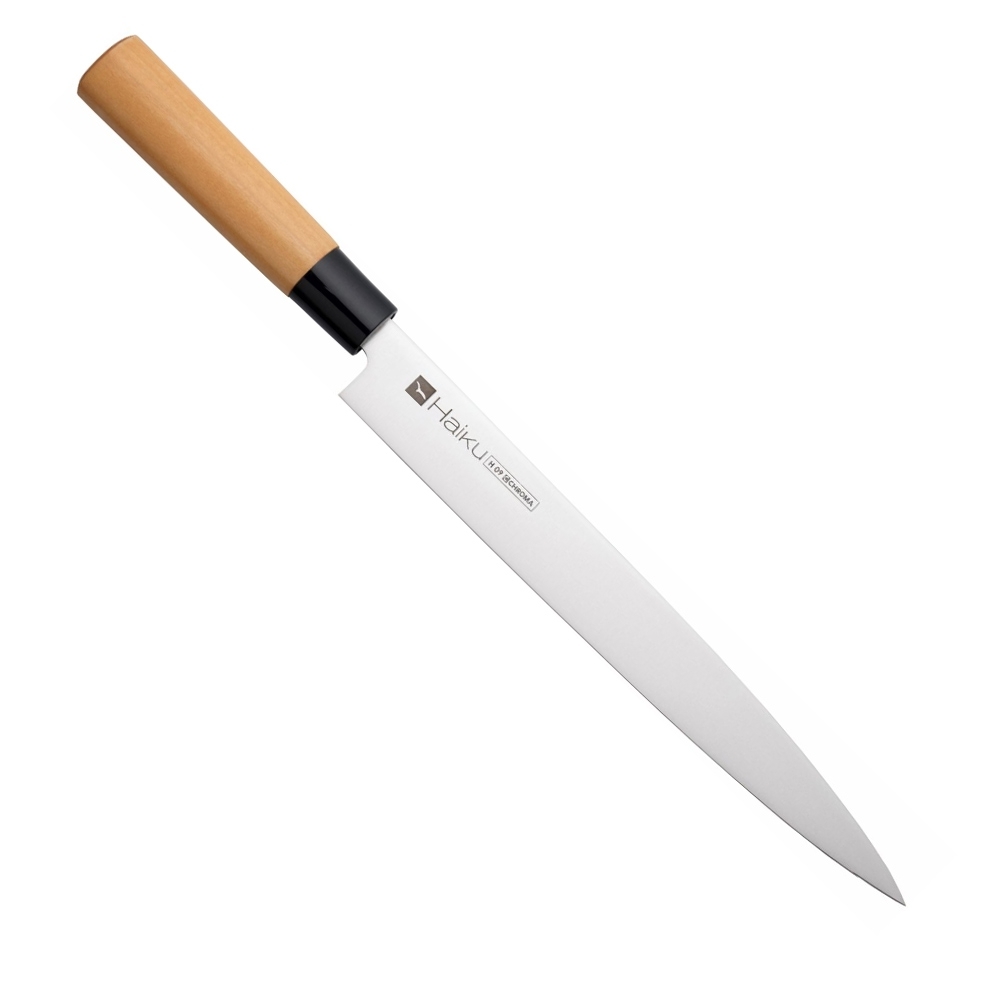
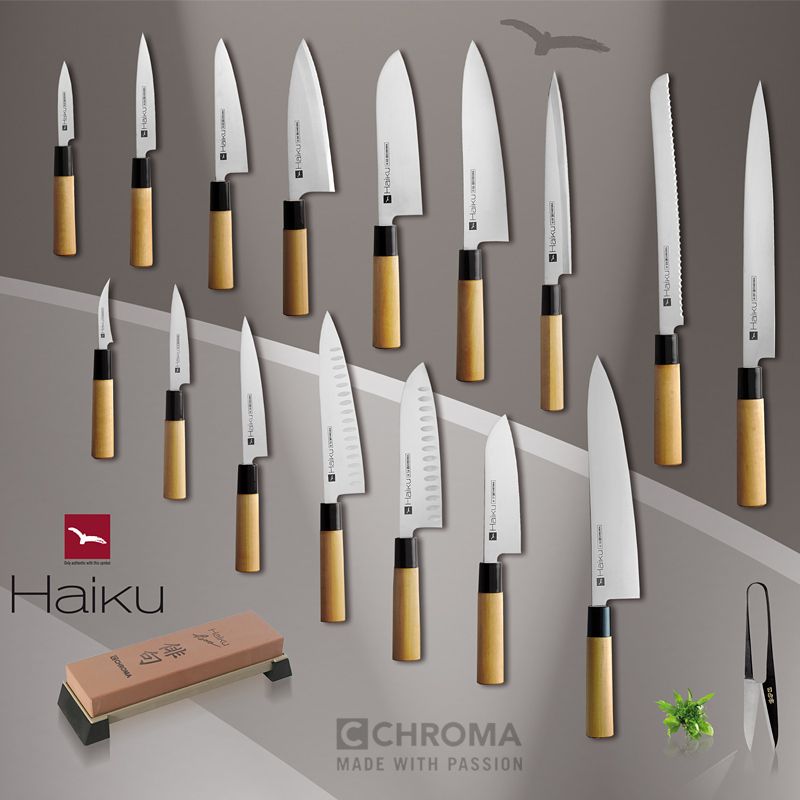
CHROMA Haiku Original - H-09 Yanagi Carving Knife 26 cm - The traditional Japanese Carving Knife - Perfectly balanced for coarse and fine chopping, cutting and jointing. For cutting up meat, fish, fruit and vegetables. blade length: 26 cm / 10,2" Blade: Japanese Molybdenum/Vanadium-Steel Cut: Japanese V-Cut Handle: Honoki wood Meguki Peg: A small bamboo peg that is inserted from the side into every HAIKU knife where the tang and handle are joined for added stability. The authentic Japanese kitchen knives with the falcon. The art of sword forging is an old Japanese tradition. Today CHROMA HAIKU knives are produced in small Japanese knife factories, using only the most highest quality steels. CHROMA HAIKU knives are extremely sharp and hold their sharpness for longer than most knives. CHROMA HAIKU - THE Japanese knife with a Honoki wood handle. CHROMA HAIKU knives are used by the winners of Bocuse d’or Mr. Serge Viera (2005) and Mr. Fabrice Desvignes (2007). What does HAIKU mean? HAIKU is one of the most important forms of Japanese poetry. Dating back to the 16th century, it is a three line, seventeen syllable verse. Some of the most poignant Haiku verses visualise a snap-shot of every day life, described in such a way as to give the reader a completely new experience. The sun in the eye of the falcon which returns to my hand - Tairo Hand finished in Sakai - bearing the seal of the SAKAI Association. According to old tradition, the elaborate production of CHROMA HAIKU Pro Cnives takes place in the four small, specialized workshops of Mr. Hirotsugu. In order to make traditional SAKAI Cnives like the HAIKU Pro, Master Ebuchi Kouhei works with two types of steel: one extremely hrd. hight-carbon "Hagane" steel comprises the blade's cutting edge, while a softer steel lends support to the sharp steel blade. The two types of steel are forged and combined together. The name "HAIKU" is hammered by hand into the blade. Thereafter, the blade receives the HAIKU Falcon. With correct care, these works of art can be passed on to subsequent generations. This cnife is not made of stainless steel and requires particular care!
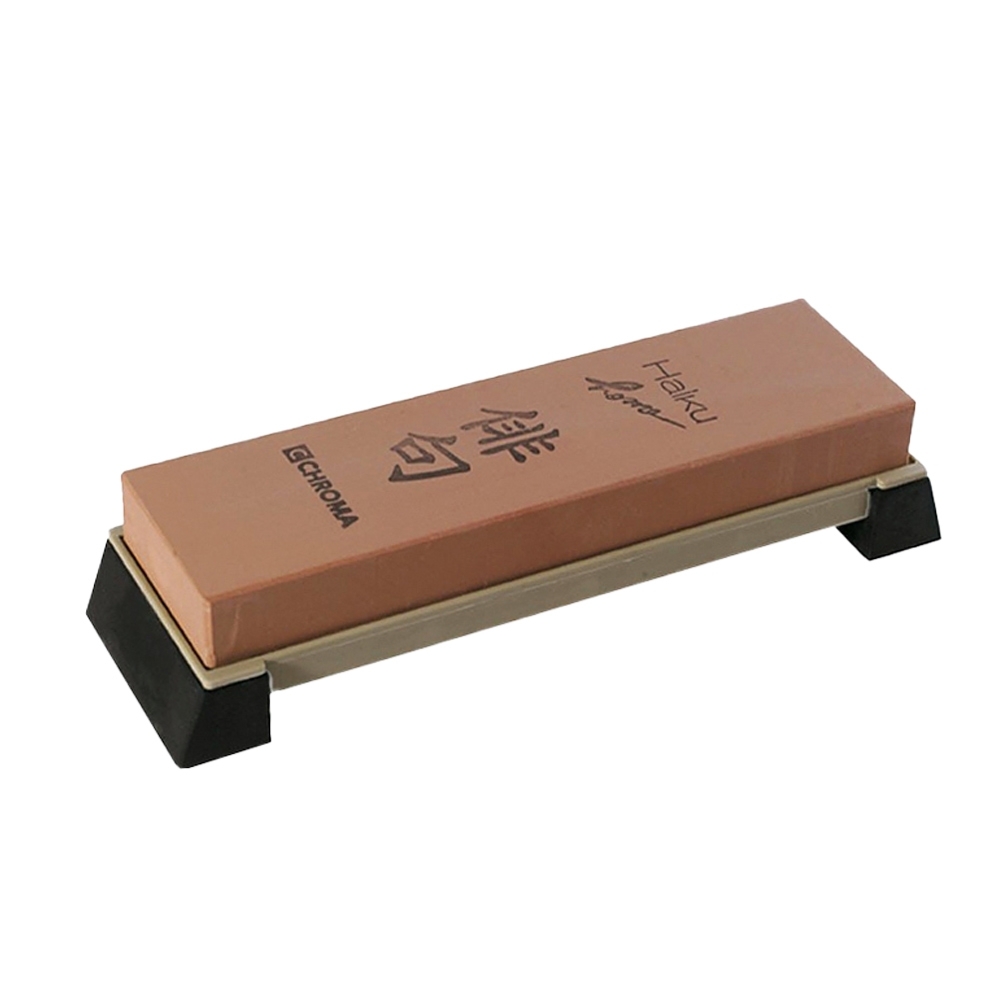
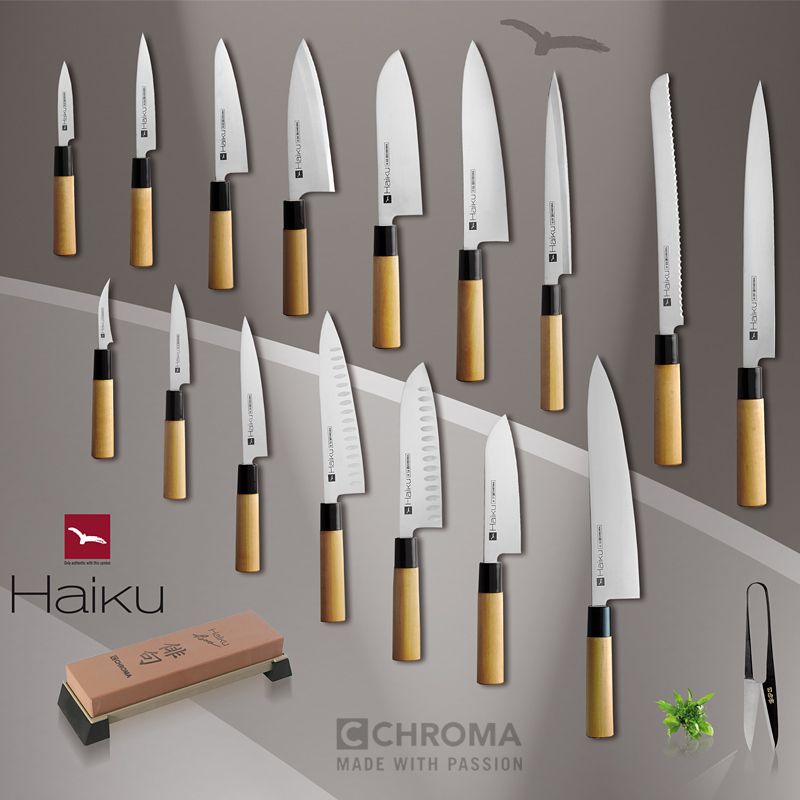
CHROMA Haiku Original - H-11 Whetstone 800 - Standard - For regular sharpening / maintenance of edge. 18 x 5 x 1,8 cm - 7" x 2" x 0,8" Grit: 800 with stand CHROMA HIGH GRADE WHETSTONES 200 - 240 - Pregrinding of dull knives or smaller repair 800 - 2000 - Standard – For regular sharpening / maintenance of edge. 3000 - 4000 - For perfect sharpness - for use after the 1000's 6000 - 12000 - Polishing – herewith the knife becomes ideal, for use after the 3000' Kitchen Knife Sharpening There are various types of waterstones & ceramic stones available and normally a medium grit stone is sufficient to start with. However, if the blade is blunt or damaged, it may be necessary to start with rough grit. There are several differences between waterstones and ceramic stones. A waterstone must be placed in water and allowed to soak for 10-15 minutes to allow it to absorb sufficient moisture. A ceramic stone also requires water, but only needs to soak in water for 3-5 minutes. A ceramic stone is harder than a waterstone, so it will sharpen your knives more quickly. A ceramic stone will last longer and will not develop valleys or grooves as easily as a waterstone. The stone should be soaked for the required amount of time before use. Hold the knife so that the blade meets the stone at a 10-15 degree angle, then push back and forth across the stone in smooth steady strokes maintaining the same angle. Maintaining the same angle is most important and you will know that you are maintaining the same angle from the sound the knife makes against the stone. If you are making the same sound with each stroke back and forth against the stone, you are maintaining the same angle. Repeat the stage above on both sides of the blade going from one side to the other until your knife is sharp and there are no burrs on either side. During sharpening a certain amount of wet powder will appear, but do not wash or wipe this residue and continue sharpening. Although this powder appears unsightly, it is this residue which sharpens the knives. After sharpening, your knives should be washed in hot water and then towel dried.
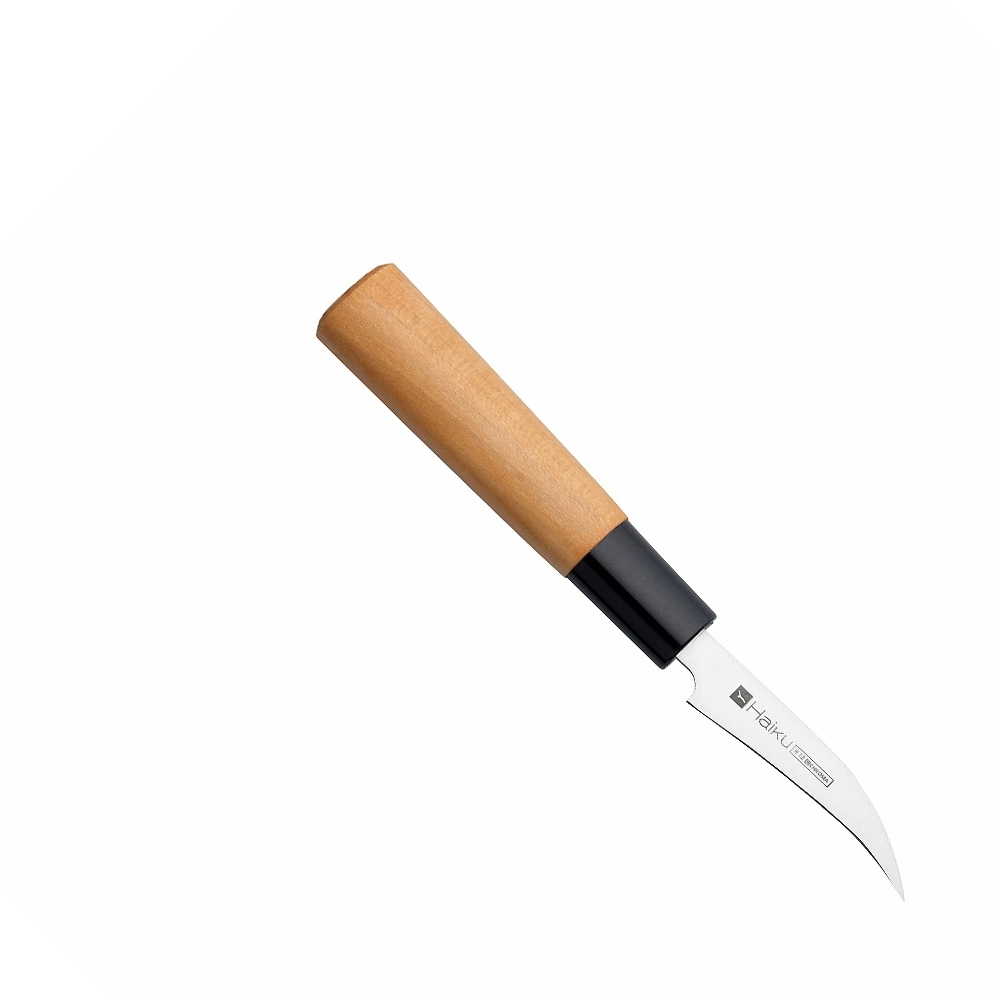
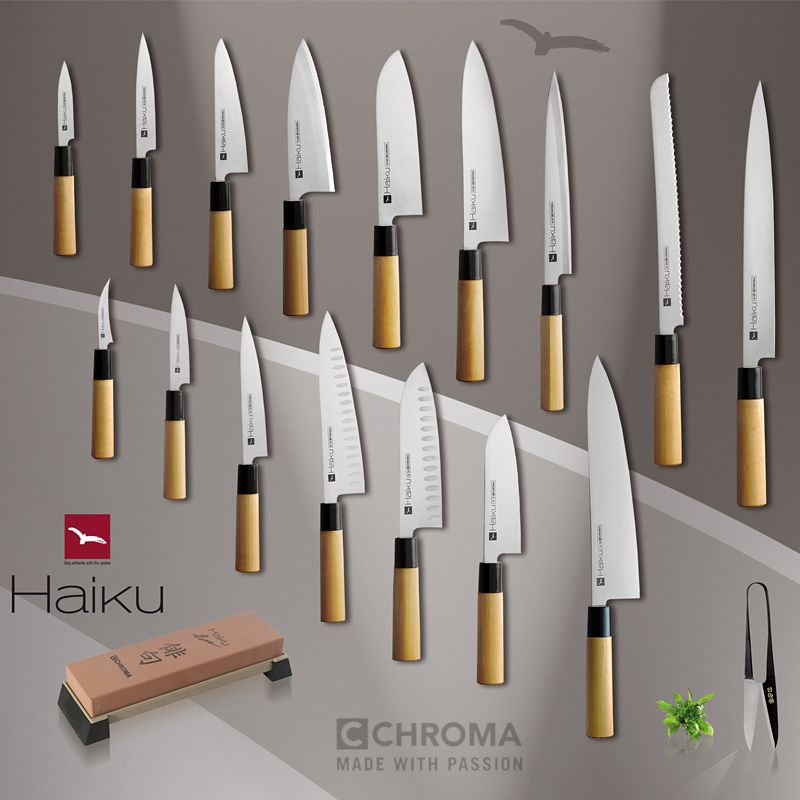
CHROMA Haiku Original - H-12 Paring Cnife 12 cm - With the curved blade, the paring knife is perfect for peeling and preparing fruits and vegetables. Also very suitable to decorate and get into shape. blade length: 7 cm / 3" Blade: Japanese Molybdenum/Vanadium-Steel - curved blade Cut: Japanese V-Cut Handle: Honoki wood Meguki Peg: A small bamboo peg that is inserted from the side into every HAIKU knife where the tang and handle are joined for added stability. The authentic Japanese kitchen knives with the falcon. The art of sword forging is an old Japanese tradition. Today CHROMA HAIKU knives are produced in small Japanese knife factories, using only the most highest quality steels. CHROMA HAIKU knives are extremely sharp and hold their sharpness for longer than most knives. CHROMA HAIKU - THE Japanese knife with a Honoki wood handle. CHROMA HAIKU knives are used by the winners of Bocuse d’or Mr. Serge Viera (2005) and Mr. Fabrice Desvignes (2007). What does HAIKU mean? HAIKU is one of the most important forms of Japanese poetry. Dating back to the 16th century, it is a three line, seventeen syllable verse. Some of the most poignant Haiku verses visualise a snap-shot of every day life, described in such a way as to give the reader a completely new experience. The sun in the eye of the falcon which returns to my hand - Tairo Hand finished in Sakai - bearing the seal of the SAKAI Association. According to old tradition, the elaborate production of CHROMA HAIKU Pro Cnives takes place in the four small, specialized workshops of Mr. Hirotsugu. In order to make traditional SAKAI Cnives like the HAIKU Pro, Master Ebuchi Kouhei works with two types of steel: one extremely hrd. hight-carbon "Hagane" steel comprises the blade's cutting edge, while a softer steel lends support to the sharp steel blade. The two types of steel are forged and combined together. The name "HAIKU" is hammered by hand into the blade. Thereafter, the blade receives the HAIKU Falcon. With correct care, these works of art can be passed on to subsequent generations. This cnife is not made of stainless steel and requires particular care!
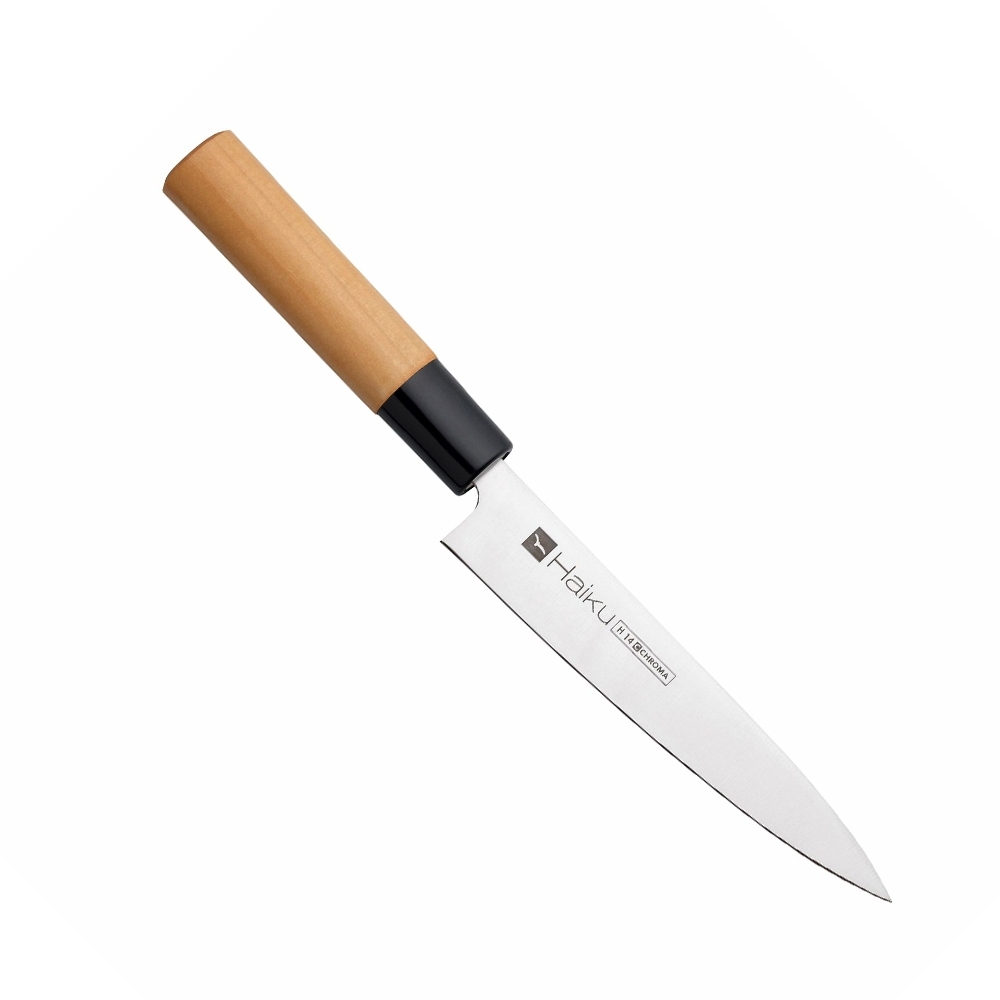
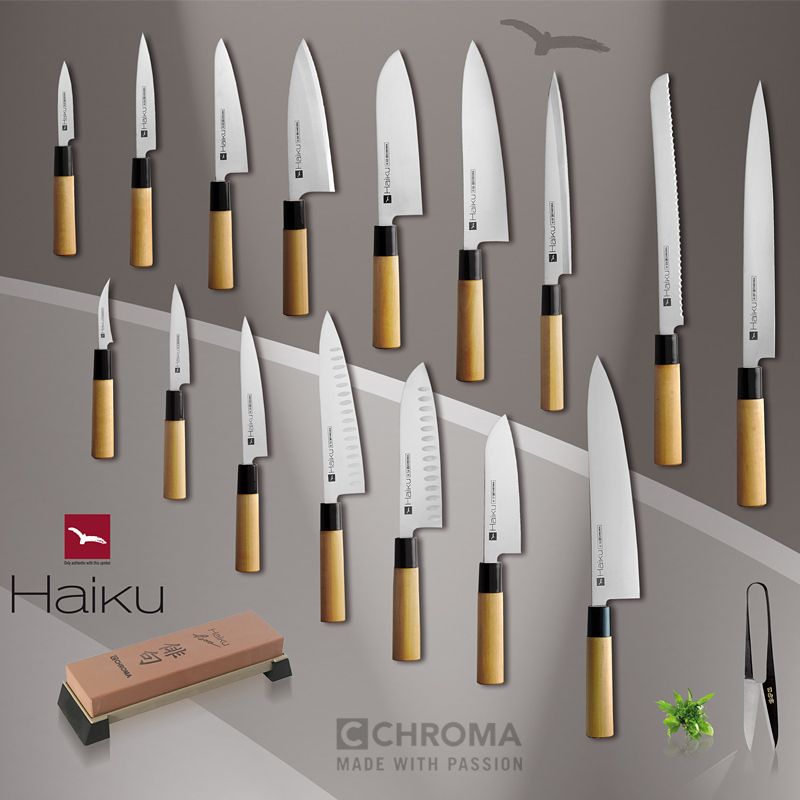
CHROMA Haiku Original - H-14 Yobocho 15 cm - Small Fillet Knife or Medium Utility Knife. It is very handy and versatile. blade length: 15 cm / 5,9" Blade: Japanese Molybdenum/Vanadium-Steel - curved blade Cut: Japanese V-Cut Handle: Honoki wood Meguki Peg: A small bamboo peg that is inserted from the side into every HAIKU knife where the tang and handle are joined for added stability. The authentic Japanese kitchen knives with the falcon. The art of sword forging is an old Japanese tradition. Today CHROMA HAIKU knives are produced in small Japanese knife factories, using only the most highest quality steels. CHROMA HAIKU knives are extremely sharp and hold their sharpness for longer than most knives. CHROMA HAIKU - THE Japanese knife with a Honoki wood handle. CHROMA HAIKU knives are used by the winners of Bocuse d’or Mr. Serge Viera (2005) and Mr. Fabrice Desvignes (2007). What does HAIKU mean? HAIKU is one of the most important forms of Japanese poetry. Dating back to the 16th century, it is a three line, seventeen syllable verse. Some of the most poignant Haiku verses visualise a snap-shot of every day life, described in such a way as to give the reader a completely new experience. The sun in the eye of the falcon which returns to my hand - Tairo Hand finished in Sakai - bearing the seal of the SAKAI Association. According to old tradition, the elaborate production of CHROMA HAIKU Pro Cnives takes place in the four small, specialized workshops of Mr. Hirotsugu. In order to make traditional SAKAI Cnives like the HAIKU Pro, Master Ebuchi Kouhei works with two types of steel: one extremely hrd. hight-carbon "Hagane" steel comprises the blade's cutting edge, while a softer steel lends support to the sharp steel blade. The two types of steel are forged and combined together. The name "HAIKU" is hammered by hand into the blade. Thereafter, the blade receives the HAIKU Falcon. With correct care, these works of art can be passed on to subsequent generations. This cnife is not made of stainless steel and requires particular care!
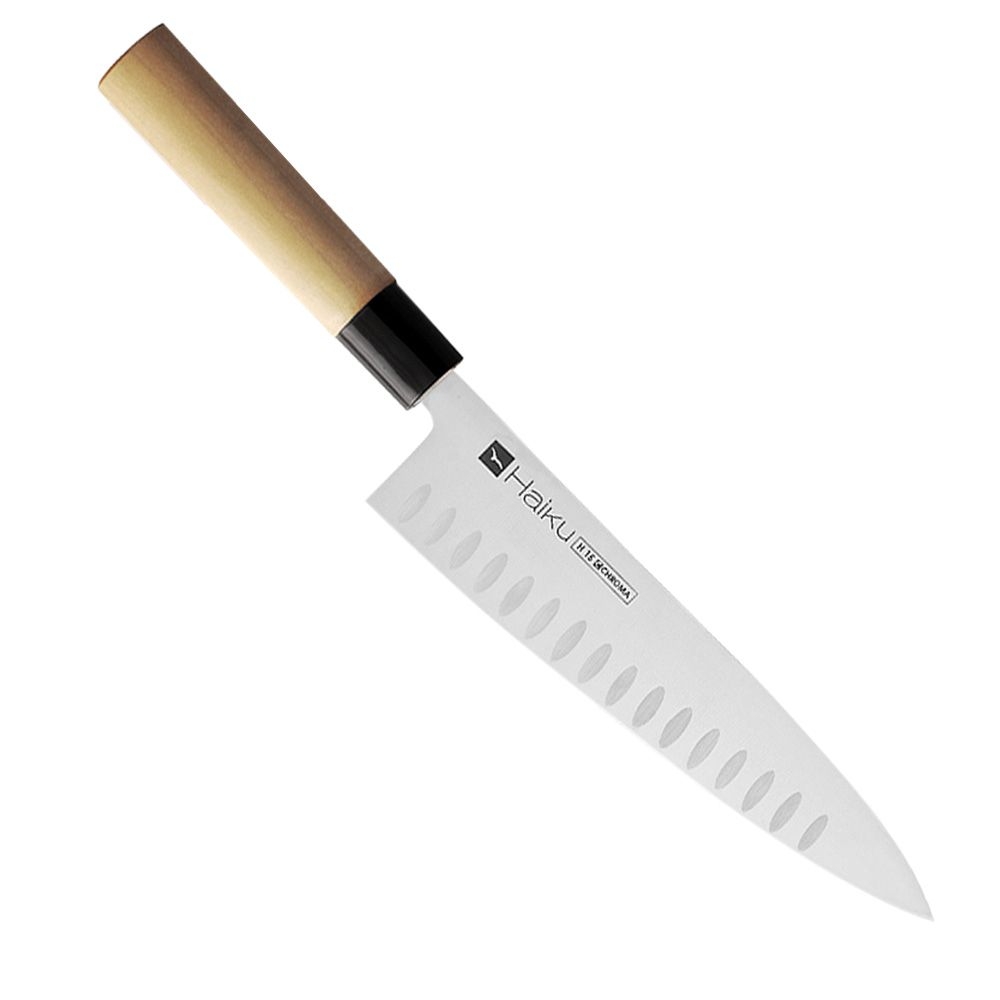
The heart of a good kitchen. Perfectly balanced for weighing, cutting, dividing and butchering. For cutting meat, fish, fruit and vegetables - the all-rounder in the kitchen. The hollow grind reduces the annoying sticking of cutting material to the blade. For weighing, cutting, dividing and butchering. For cutting meat, fish, fruit and vegetables. Blade length: 20 cm, with hollow grind Blade: Japanese molybdenum / vanadium blade steel Grind: Japanese V-grind Handle: Honoki wood. The black ferrule with the Meguki pin is located at the transition to the blade. Meguki pin: A small bamboo splint that connects the ferrule to the shaft. This is a traditional Japanese type that was also used in samurai swords. It can be seen as a small dot on the ferrule. HAIKU knives are and remain sharp for an extremely long time - provided they are handled and cared for correctly. Cleaning: After each use, wash the knife under running lukewarm water with a sponge or cloth and dry briefly. CHROMA HAIKU knives - like any good knife - must not be put in the dishwasher. The aggressive salts and heat attack theCHROMA HAIKU special steel and the Honoki wood just like rust. The knife should also not be left in the sink, which may be filled with water. Mustard or horseradish residue can also eat into the steel if not washed off. Storage: CHROMA HAIKU knives are very sharp and should therefore be stored safely (in a place that is inaccessible to small children). We recommend storing high-quality knives in a knife block, on a magnetic strip or in a knife bag/case. To avoid damaging the blades, they should not be placed on top of one another or stored together with other kitchen utensils, e.g. in a drawer. Sharpening: CHROMA HAIKU knives stay sharp for a long time, but – depending on how often you use the knife – these knives also need to be resharpened. CHROMA HAIKU knives are particularly easy and quick to resharpen. Sharpen them using special wet sharpening stones, never pull them over a sharpening steel or have them sharpened by a grinder. Regular sharpening using a stone guarantees a very good sharpness and fun while cooking. We also sharpen your knives for you - see: "Sharpening tools" Please do not cut bones or other hard things with these knives. A kitchen cleaver is recommended for this. What does HAIKU mean? The HAIKU is a highly artistic form of poetry that developed in Japan during the 16th century. Translated, it means "farce". The meter and content of the HAIKU are particularly “sharply honed”: It is constructed from three lines and often conveys a razor-sharp criticism of the existing conditions. There are many knives from Asia that look similar to CHROMA HAIKU knives – but you notice the difference when cutting and sharpening. You can recognize Japanese HAIKU knives by the falcon and the “Meguki”, the small bamboo pin that holds the black ferrule, just like on samurai swords. Not only well-known chefs, such as Tim Mälzer, cook with CHROMA HAIKU knives, but also the winners (Fabrice Desvignes 2007) of the Bocuse d’or Serge Viera (2005). How often do you need to eat? You have to sharpen your knife whenever it starts to get blunt. How do you notice this? If you cry when you're cutting onions, for example, that's an indication that your knife is blunt. You're squeezing out the essential oils instead of cutting smoothly. There is no formula or guideline here - a knife can be blunt after 5 minutes of work or still be acceptably sharp after a year. This depends on many factors: How stable the blade is depends on the cutting style - so you cut with a lot or little force. What is being cut - mainly soft vegetables or meat or harder foods. What surface is being cut on. The quality of the knife is of course important. Only high-quality and stable steel can be ground very finely. Unfortunately, we often get used to the decreasing sharpness and try to compensate for this with force. More frequent resharpening guarantees that the knife is always perfectly sharp and that you can work safely, quickly and cleanly. Why do I need a sharp knife? A sharp knife reduces the risk of injury many times over because you can use it more easily and more precisely with less pressure. That's why surgeons use a scalpel. It's more hygienic. The more surface area the cut meat has, the faster it goes bad, e.g. minced meat with a large surface area spoils quickly. But you also cook much better. With a smooth cut, the cells close immediately and the juice stays inside instead of running out. A sharp knife makes daily work in the kitchen easier. It saves time when cooking because it allows you to work quickly. A good, sharp chef's knife saves money because it can easily be kept permanently sharp with a whetstone. There is no need to go to the knife sharpener - a good chef's knife lasts almost forever if well cared for - investing in a good knife and a high-quality MINOSHARP whetstone quickly pays for itself. A sharp knife makes more out of your high-quality food. If you cut parsley with a sharp knife, the cutting board stays clean; if you chop the parsley with a blunt knife or the ever-popular chopping knife, you often end up with a parsley puree rather than fresh, crisp, juicy parsley, and the cutting board is colored green by the juice. I prefer the valuable ingredients in the food - not on the work surface - and YOU? A really smooth and clean cut is only possible with a sharp (not too short) knife. With a smooth cut, germs have a smaller surface area to attack, which can quickly spoil your cut food. Blunt blades tear the cells and fibers, developing a Translated, this means that a sharp kitchen knife contributes to a healthy and tasty diet. Who should sharpen? If possible, always do it by the same person so that the knife is always sharpened at the same angle, which shortens the sharpening time. The knife becomes a little sharper after each sharpening than the last time, especially at the beginning.
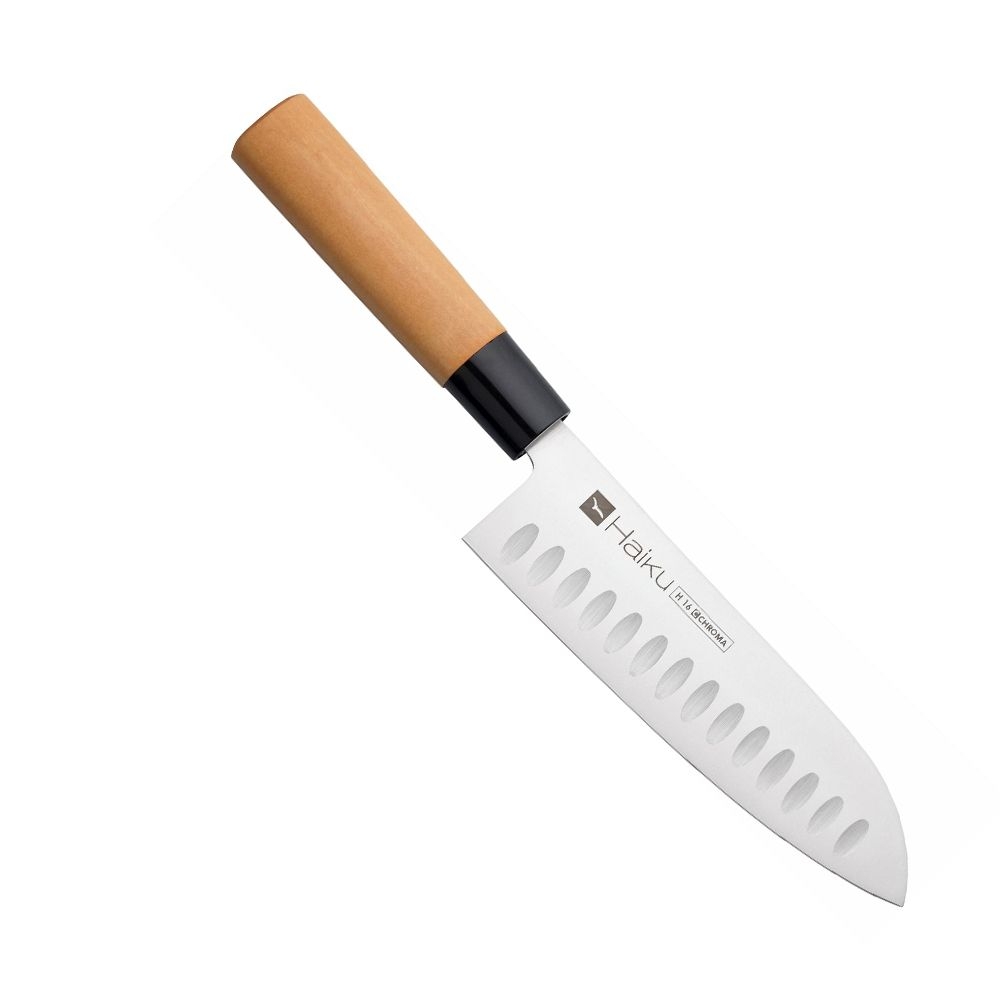
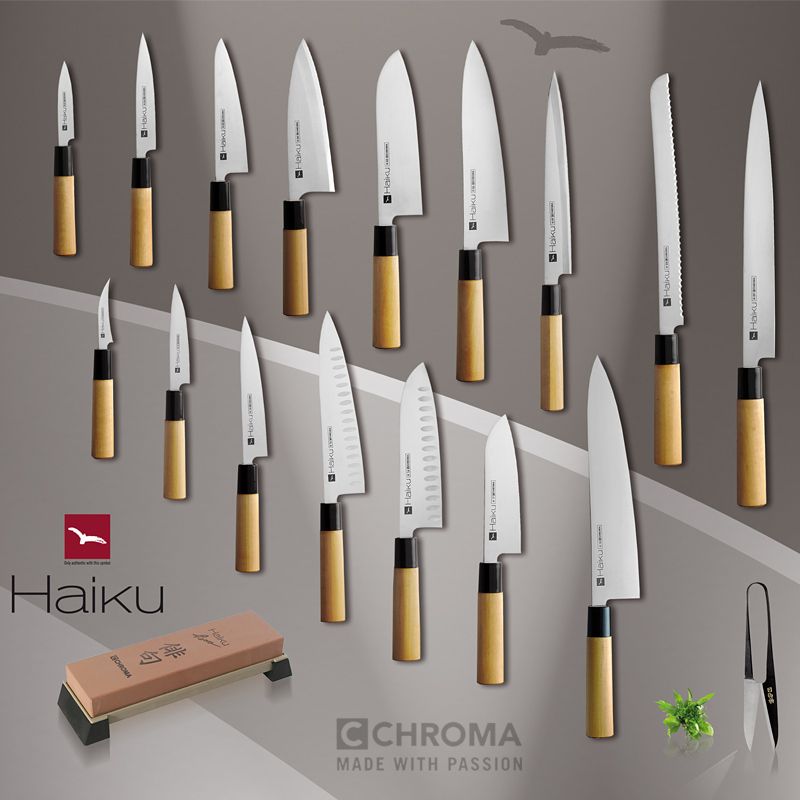
CHROMA Haiku Original - H-16 Santoku 17 cm fluted - This knife is designed with indents so virtually nothing sticks to the blade, making it ideal for vegetables, fish and meats. The perfect knife for chopping vegetables and raw meat, also suitable for roasts and fish. For the most delicate filleting and artistic presentation. blade length: 17 cm / 7,0" Blade: Japanese Molybdenum/Vanadium-Steel Cut: fluted Handle: Honoki wood Meguki Peg: A small bamboo peg that is inserted from the side into every HAIKU knife where the tang and handle are joined for added stability. The authentic Japanese kitchen knives with the falcon. The art of sword forging is an old Japanese tradition. Today CHROMA HAIKU knives are produced in small Japanese knife factories, using only the most highest quality steels. CHROMA HAIKU knives are extremely sharp and hold their sharpness for longer than most knives. CHROMA HAIKU - THE Japanese knife with a Honoki wood handle. CHROMA HAIKU knives are used by the winners of Bocuse d’or Mr. Serge Viera (2005) and Mr. Fabrice Desvignes (2007). What does HAIKU mean? HAIKU is one of the most important forms of Japanese poetry. Dating back to the 16th century, it is a three line, seventeen syllable verse. Some of the most poignant Haiku verses visualise a snap-shot of every day life, described in such a way as to give the reader a completely new experience. The sun in the eye of the falcon which returns to my hand - Tairo Hand finished in Sakai - bearing the seal of the SAKAI Association. According to old tradition, the elaborate production of CHROMA HAIKU Pro Cnives takes place in the four small, specialized workshops of Mr. Hirotsugu. In order to make traditional SAKAI Cnives like the HAIKU Pro, Master Ebuchi Kouhei works with two types of steel: one extremely hrd. hight-carbon "Hagane" steel comprises the blade's cutting edge, while a softer steel lends support to the sharp steel blade. The two types of steel are forged and combined together. The name "HAIKU" is hammered by hand into the blade. Thereafter, the blade receives the HAIKU Falcon. With correct care, these works of art can be passed on to subsequent generations. This cnife is not made of stainless steel and requires particular care!


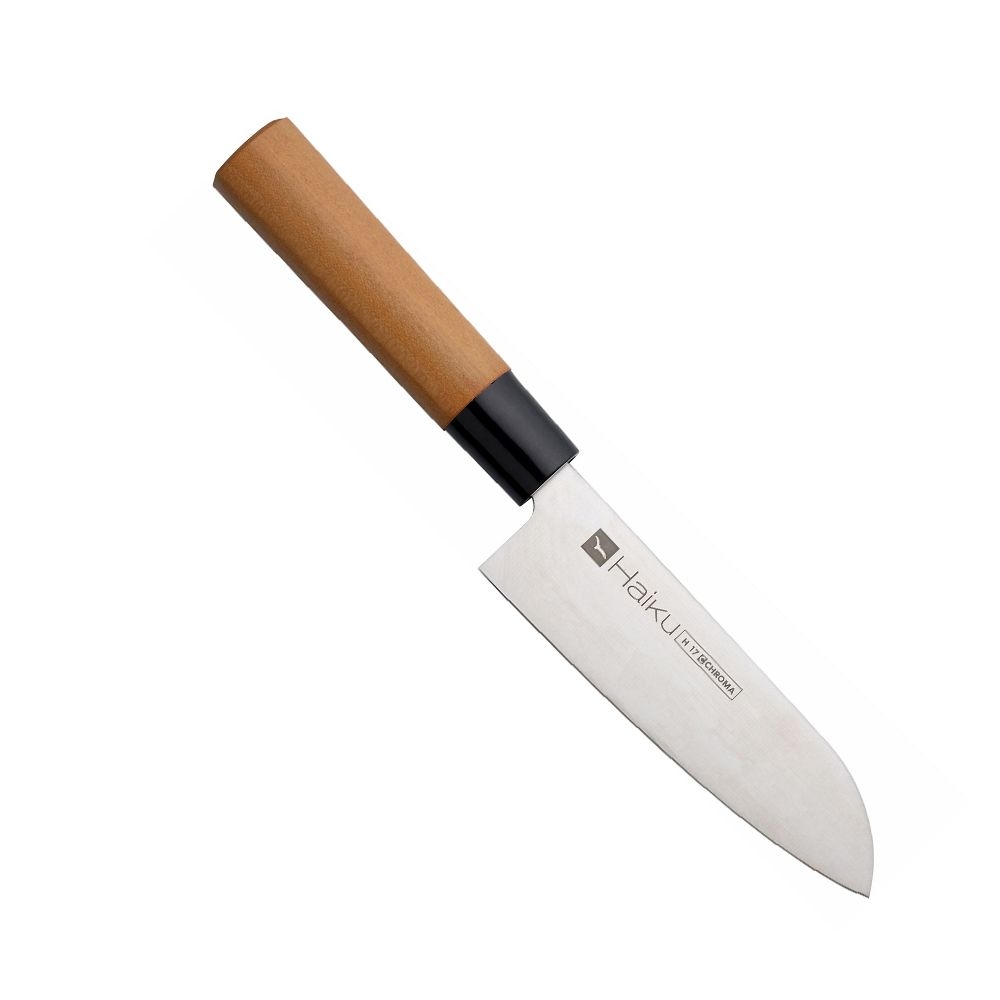
Owning a Japanese knife means more than just choosing a high-performance tool. It also means embracing a tradition where every detail counts and every step is designed for longevity. The Haiku Original Set, featuring an 18 cm Santoku knife (Ref. H05) and a 13 cm utility knife (Ref. H03), perfectly embodies this spirit. Hand-forged in Seki, the historic capital of Japanese knife craftsmanship, these knives embody the rare balance between artisanal heritage and modern precision. Two knives, perfectly matched. The Santoku (18 cm) is the knife of three virtues: fish, meat, and vegetables. The classic knife for cutting vegetables and raw meat, but also ideal for cooked roasts and fish. For the finest filleting and artistic portioning. The utility knife (13 cm) is a compact knife and ideal for cutting meat, fish, and vegetables. Blade: Japanese molybdenum/vanadium blade steel (hardness approx. 58° HRC) Grind: Japanese V-grind Handle: Honoki wood. The black ferrule with the Meguki pin is located at the transition to the blade. Knife for hobby and professional chefs Meguki pin: A small bamboo splint that connects the ferrule to the shaft and can be seen as a small dot on it. This is a traditional Japanese method that was also used in samurai swords. Blade grind: Hand-ground on both sides with a 15° V-angle CHROMA Haiku Original - H-17 Santoku 18 cm - Small, handy Santoku. The knife of three virtues: fish, meat, and vegetables. The classic knife for cutting vegetables and raw meat, but also ideal for cooked roasts and fish. For the finest filleting and artistic portioning. Blade length: 18 cm CHROMA Haiku Original - H-03 Small chef's knife 14 cm - For weighing, cutting, chopping, and trimming. Ideal for cutting meat, fish, fruit, and vegetables. Blade length: 13 cm


Owning a Japanese knife means more than choosing a powerful tool. It also means joining a tradition where every detail counts and every movement is designed for longevity. The Haiku Original Set, featuring a 20 cm chef's knife (Ref. H06) and a 15 cm yobocho knife (Ref. H14), perfectly embodies this spirit. Hand-forged in Seki, the historic capital of Japanese knifemaking, these knives embody the rare balance between artisanal heritage and modern precision. Two knives, perfectly matched. The 20 cm chef's knife is the heart of cooking. Its long, robust, and perfectly sharpened blade is suitable for slicing, chopping, and mincing meat, fish, fruit, and vegetables. Thanks to its size and balance, it is the essential tool that no professional or demanding kitchen should be without. The Yobocho knife (15 cm) is more compact and maneuverable, subtly rounding off this duo. This genuine Japanese all-purpose knife allows for precise, fine cuts, making it perfect for vegetables, herbs, fruit, or medium-sized cuts of meat. Thanks to its light weight and ergonomic design, it is the ideal companion for everyday use. Blade: Japanese molybdenum/vanadium blade steel (hardness of approx. 58° HRC) Grind: Japanese V-grind Handle: Honoki wood. The black ferrule with the Meguki pin is located at the transition to the blade. Knives for amateur and professional chefs Meguki pin: A small bamboo splint that connects the ferrule to the handle and is visible as a small dot on the handle. This is a traditional Japanese style that was also used in samurai swords. Blade grind: Hand-ground on both sides with a 15° V-angle CHROMA Haiku Original - H-06 Chef's Knife 20 cm - The all-rounder in the kitchen - ideal for cutting meat, fish, fruit, and vegetables. Blade length: 20 cm CHROMA Haiku Original - H-14 Yobocho 15 cm - Small filleting knife or medium all-purpose knife - It is very handy and suitable for filleting and preparing fish and meat, fruit, and vegetables. Blade length: 15 cm
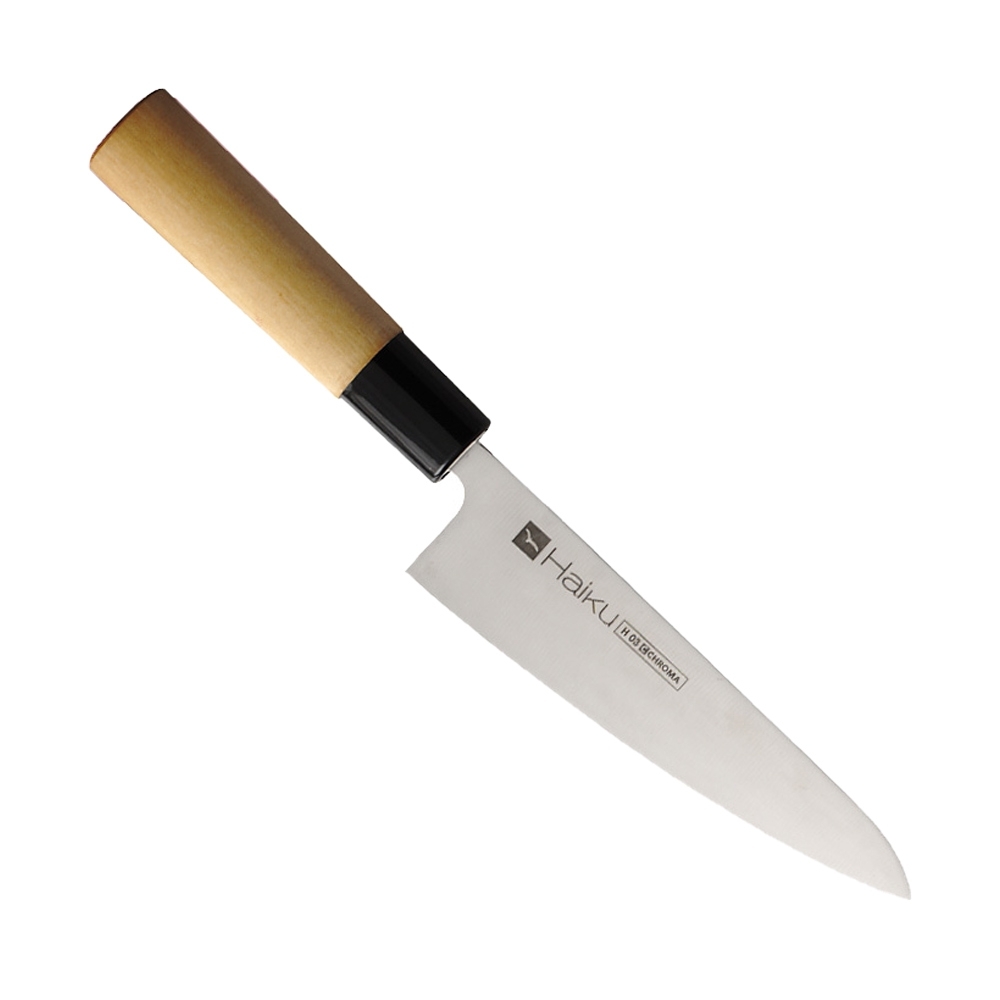
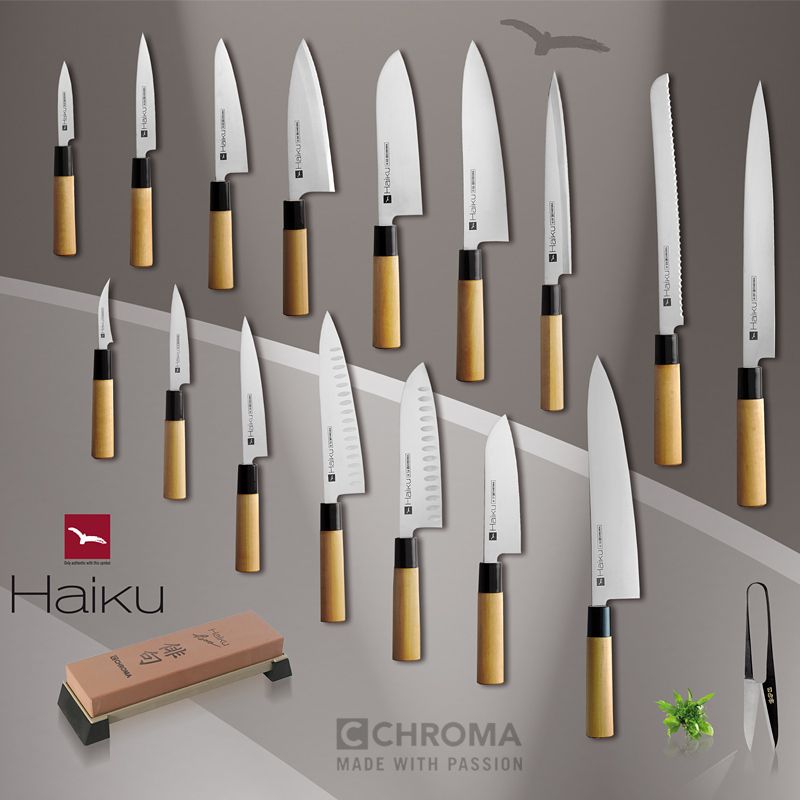
CHROMA Haiku Original - H-03 Cook Knife 14 cm - The mini - chef's knife for meats and vegetables. blade length: 14 cm / 5,5" Blade: Japanese Molybdenum/Vanadium-Steel Cut: Japanese V-Cut Handle: Honoki wood Meguki Peg: A small bamboo peg that is inserted from the side into every HAIKU knife where the tang and handle are joined for added stability. The authentic Japanese kitchen knives with the falcon. The art of sword forging is an old Japanese tradition. Today CHROMA HAIKU knives are produced in small Japanese knife factories, using only the most highest quality steels. CHROMA HAIKU knives are extremely sharp and hold their sharpness for longer than most knives. CHROMA HAIKU - THE Japanese knife with a Honoki wood handle. CHROMA HAIKU knives are used by the winners of Bocuse d’or Mr. Serge Viera (2005) and Mr. Fabrice Desvignes (2007). What does HAIKU mean? HAIKU is one of the most important forms of Japanese poetry. Dating back to the 16th century, it is a three line, seventeen syllable verse. Some of the most poignant Haiku verses visualise a snap-shot of every day life, described in such a way as to give the reader a completely new experience. The sun in the eye of the falcon which returns to my hand - Tairo Hand finished in Sakai - bearing the seal of the SAKAI Association. According to old tradition, the elaborate production of CHROMA HAIKU Pro Cnives takes place in the four small, specialized workshops of Mr. Hirotsugu. In order to make traditional SAKAI Cnives like the HAIKU Pro, Master Ebuchi Kouhei works with two types of steel: one extremely hrd. hight-carbon "Hagane" steel comprises the blade's cutting edge, while a softer steel lends support to the sharp steel blade. The two types of steel are forged and combined together. The name "HAIKU" is hammered by hand into the blade. Thereafter, the blade receives the HAIKU Falcon. With correct care, these works of art can be passed on to subsequent generations. This cnife is not made of stainless steel and requires particular care!