
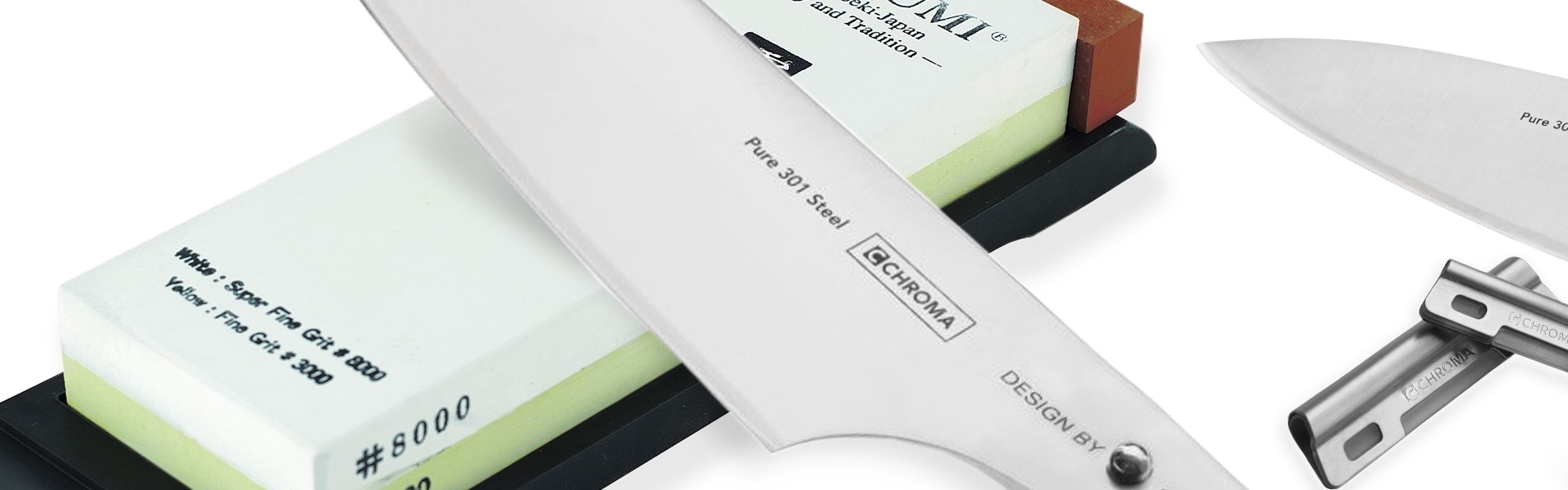


The combined grinding stone CHROMA ST-2/8 has the grain sizes 200 and 800. With the raw size 200 you can repair small blade imperfections. With the smoother size 800 you can carry out the real grinding. 18 x 6,3 x 2,8 cm Grit: 200 / 800 Ideally, the knife should be sharpened daily (for professional cooks) or about every six months (for hobby cooks), and by the same person each time or with the help of a ‘sharping guide‘. Each person has an individual angle at which he or she sharpens the knife. The blade of the knife becomes sharper each time it is sharpened in the same manner, by the same person or with the help of an optional attachable ‘sharping guide‘. This ‘sharping guide‘ helps you hold knife’s edge at 15-20 degree angle when sharpening – the ideal angle. Kitchen Knife Sharpening There are various types of waterstones & ceramic stones available and normally a medium grit stone is sufficient to start with. However, if the blade is blunt or damaged, it may be necessary to start with rough grit. There are several differences between waterstones and ceramic stones. A waterstone must be placed in water and allowed to soak for 10-15 minutes to allow it to absorb sufficient moisture. A ceramic stone also requires water, but only needs to soak in water for 3-5 minutes. A ceramic stone is harder than a waterstone, so it will sharpen your knives more quickly. A ceramic stone will last longer and will not develop valleys or grooves as easily as a waterstone. The stone should be soaked for the required amount of time before use. Hold the knife so that the blade meets the stone at a 10-15 degree angle, then push back and forth across the stone in smooth steady strokes maintaining the same angle. Maintaining the same angle is most important and you will know that you are maintaining the same angle from the sound the knife makes against the stone. If you are making the same sound with each stroke back and forth against the stone, you are maintaining the same angle. Repeat the stage above on both sides of the blade going from one side to the other until your knife is sharp and there are no burrs on either side. During sharpening a certain amount of wet powder will appear, but do not wash or wipe this residue and continue sharpening. Although this powder appears unsightly, it is this residue which sharpens the knives. After sharpening, your knives should be washed in hot water and then towel dried.


Chroma - Ceramic Whetstone ST-1/6 - Grit: 1000 / 6000 - Care and proper use of a high-quality knife is always essential to maintain the best cutting edge and to insure the highest possible degree of safety when using. After all, a dull knife is a dangerous knife. The more pressure required to cut with a knife the greater chance of an accident occurring while it is being used. 18,2 x 6,1 x 2,5 cm grit: 1000 / 6500 with stand incl. Shusei Toishi Ideally, the knife should be sharpened daily (for professional cooks) or about every six months (for hobby cooks), and by the same person each time or with the help of a ‘sharping guide‘. Each person has an individual angle at which he or she sharpens the knife. The blade of the knife becomes sharper each time it is sharpened in the same manner, by the same person or with the help of an optional attachable ‘sharping guide‘. This ‘sharping guide‘ helps you hold knife’s edge at 15-20 degree angle when sharpening – the ideal angle. CHROMA HIGH GRADE WHETSTONES 200 - 240 - Pregrinding of dull knives or smaller repair 800 - 2000 - Standard – For regular sharpening / maintenance of edge. 3000 - 4000 - For perfect sharpness - for use after the 1000's 6000 - 12000 - Polishing – herewith the knife becomes ideal, for use after the 3000' Kitchen Knife Sharpening There are various types of waterstones & ceramic stones available and normally a medium grit stone is sufficient to start with. However, if the blade is blunt or damaged, it may be necessary to start with rough grit. There are several differences between waterstones and ceramic stones. A waterstone must be placed in water and allowed to soak for 10-15 minutes to allow it to absorb sufficient moisture. A ceramic stone also requires water, but only needs to soak in water for 3-5 minutes. A ceramic stone is harder than a waterstone, so it will sharpen your knives more quickly. A ceramic stone will last longer and will not develop valleys or grooves as easily as a waterstone. The stone should be soaked for the required amount of time before use. Hold the knife so that the blade meets the stone at a 10-15 degree angle, then push back and forth across the stone in smooth steady strokes maintaining the same angle. Maintaining the same angle is most important and you will know that you are maintaining the same angle from the sound the knife makes against the stone. If you are making the same sound with each stroke back and forth against the stone, you are maintaining the same angle. Repeat the stage above on both sides of the blade going from one side to the other until your knife is sharp and there are no burrs on either side. During sharpening a certain amount of wet powder will appear, but do not wash or wipe this residue and continue sharpening. Although this powder appears unsightly, it is this residue which sharpens the knives. After sharpening, your knives should be washed in hot water and then towel dried.


CHROMA Whetstone ST-1000 - The standard stone for the regular cut. Our Top-selling! 18,2 x 6,1 x 2,5 cm grit: 1000 with stand CHROMA HIGH GRADE WHETSTONES 200 - 240 - Pregrinding of dull knives or smaller repair 800 - 2000 - Standard – For regular sharpening / maintenance of edge. 3000 - 4000 - For perfect sharpness - for use after the 1000's 6000 - 12000 - Polishing – herewith the knife becomes ideal, for use after the 3000' Kitchen Knife Sharpening There are various types of waterstones & ceramic stones available and normally a medium grit stone is sufficient to start with. However, if the blade is blunt or damaged, it may be necessary to start with rough grit. There are several differences between waterstones and ceramic stones. A waterstone must be placed in water and allowed to soak for 10-15 minutes to allow it to absorb sufficient moisture. A ceramic stone also requires water, but only needs to soak in water for 3-5 minutes. A ceramic stone is harder than a waterstone, so it will sharpen your knives more quickly. A ceramic stone will last longer and will not develop valleys or grooves as easily as a waterstone. The stone should be soaked for the required amount of time before use. Hold the knife so that the blade meets the stone at a 10-15 degree angle, then push back and forth across the stone in smooth steady strokes maintaining the same angle. Maintaining the same angle is most important and you will know that you are maintaining the same angle from the sound the knife makes against the stone. If you are making the same sound with each stroke back and forth against the stone, you are maintaining the same angle. Repeat the stage above on both sides of the blade going from one side to the other until your knife is sharp and there are no burrs on either side. During sharpening a certain amount of wet powder will appear, but do not wash or wipe this residue and continue sharpening. Although this powder appears unsightly, it is this residue which sharpens the knives. After sharpening, your knives should be washed in hot water and then towel dried.


CHROMA Whetstone ST-1800L - Double-sided Whetstone - 240/1000 Grit 240: Pregrinding of dull knives or smaller repair Grit 1000: Standard – For regular sharpening / maintenance of edge. 18 x 6,3 x 2,8 cm grit: 240/1000 with stand CHROMA HIGH GRADE WHETSTONES 200 - 240 - Pregrinding of dull knives or smaller repair 800 - 2000 - Standard – For regular sharpening / maintenance of edge. 3000 - 4000 - For perfect sharpness - for use after the 1000's 6000 - 12000 - Polishing – herewith the knife becomes ideal, for use after the 3000' Kitchen Knife Sharpening There are various types of waterstones & ceramic stones available and normally a medium grit stone is sufficient to start with. However, if the blade is blunt or damaged, it may be necessary to start with rough grit. There are several differences between waterstones and ceramic stones. A waterstone must be placed in water and allowed to soak for 10-15 minutes to allow it to absorb sufficient moisture. A ceramic stone also requires water, but only needs to soak in water for 3-5 minutes. A ceramic stone is harder than a waterstone, so it will sharpen your knives more quickly. A ceramic stone will last longer and will not develop valleys or grooves as easily as a waterstone. The stone should be soaked for the required amount of time before use. Hold the knife so that the blade meets the stone at a 10-15 degree angle, then push back and forth across the stone in smooth steady strokes maintaining the same angle. Maintaining the same angle is most important and you will know that you are maintaining the same angle from the sound the knife makes against the stone. If you are making the same sound with each stroke back and forth against the stone, you are maintaining the same angle. Repeat the stage above on both sides of the blade going from one side to the other until your knife is sharp and there are no burrs on either side. During sharpening a certain amount of wet powder will appear, but do not wash or wipe this residue and continue sharpening. Although this powder appears unsightly, it is this residue which sharpens the knives. After sharpening, your knives should be washed in hot water and then towel dried.

CHROMA Whetstone ST-1800S - Double-sided Whetstone - 240/1000 Grit 240: Pregrinding of dull knives or smaller repair Grit 1000: Standard – For regular sharpening / maintenance of edge. 18,3 x 6,1 x 2,5 cm grit: 240/1000 with stand CHROMA HIGH GRADE WHETSTONES 200 - 240 - Pregrinding of dull knives or smaller repair 800 - 2000 - Standard – For regular sharpening / maintenance of edge. 3000 - 4000 - For perfect sharpness - for use after the 1000's 6000 - 12000 - Polishing – herewith the knife becomes ideal, for use after the 3000' Kitchen Knife Sharpening There are various types of waterstones & ceramic stones available and normally a medium grit stone is sufficient to start with. However, if the blade is blunt or damaged, it may be necessary to start with rough grit. There are several differences between waterstones and ceramic stones. A waterstone must be placed in water and allowed to soak for 10-15 minutes to allow it to absorb sufficient moisture. A ceramic stone also requires water, but only needs to soak in water for 3-5 minutes. A ceramic stone is harder than a waterstone, so it will sharpen your knives more quickly. A ceramic stone will last longer and will not develop valleys or grooves as easily as a waterstone. The stone should be soaked for the required amount of time before use. Hold the knife so that the blade meets the stone at a 10-15 degree angle, then push back and forth across the stone in smooth steady strokes maintaining the same angle. Maintaining the same angle is most important and you will know that you are maintaining the same angle from the sound the knife makes against the stone. If you are making the same sound with each stroke back and forth against the stone, you are maintaining the same angle. Repeat the stage above on both sides of the blade going from one side to the other until your knife is sharp and there are no burrs on either side. During sharpening a certain amount of wet powder will appear, but do not wash or wipe this residue and continue sharpening. Although this powder appears unsightly, it is this residue which sharpens the knives. After sharpening, your knives should be washed in hot water and then towel dried.


CHROMA Whetstone ST-240 - The Whetstone for very dull blades and light repairs. 21 x 7,5 x 2,3 cm grit: 240 with stand CHROMA HIGH GRADE WHETSTONES 200 - 240 - Pregrinding of dull knives or smaller repair 800 - 2000 - Standard – For regular sharpening / maintenance of edge. 3000 - 4000 - For perfect sharpness - for use after the 1000's 6000 - 12000 - Polishing – herewith the knife becomes ideal, for use after the 3000' Kitchen Knife Sharpening There are various types of waterstones & ceramic stones available and normally a medium grit stone is sufficient to start with. However, if the blade is blunt or damaged, it may be necessary to start with rough grit. There are several differences between waterstones and ceramic stones. A waterstone must be placed in water and allowed to soak for 10-15 minutes to allow it to absorb sufficient moisture. A ceramic stone also requires water, but only needs to soak in water for 3-5 minutes. A ceramic stone is harder than a waterstone, so it will sharpen your knives more quickly. A ceramic stone will last longer and will not develop valleys or grooves as easily as a waterstone. The stone should be soaked for the required amount of time before use. Hold the knife so that the blade meets the stone at a 10-15 degree angle, then push back and forth across the stone in smooth steady strokes maintaining the same angle. Maintaining the same angle is most important and you will know that you are maintaining the same angle from the sound the knife makes against the stone. If you are making the same sound with each stroke back and forth against the stone, you are maintaining the same angle. Repeat the stage above on both sides of the blade going from one side to the other until your knife is sharp and there are no burrs on either side. During sharpening a certain amount of wet powder will appear, but do not wash or wipe this residue and continue sharpening. Although this powder appears unsightly, it is this residue which sharpens the knives. After sharpening, your knives should be washed in hot water and then towel dried.


CHROMA Whetstone ST-3/8 - After grinding with the ST-1000 - used this Whetstone with the 3000 grit for the perfect sharpness and then 8000 grit for polishing. 18,3 x 6,1 x 2,5 cm grit: 3000 & 8000 with stand incl. Toishi CHROMA HIGH GRADE WHETSTONES 200 - 240 - Pregrinding of dull knives or smaller repair 800 - 2000 - Standard – For regular sharpening / maintenance of edge. 3000 - 4000 - For perfect sharpness - for use after the 1000's 6000 - 12000 - Polishing – herewith the knife becomes ideal, for use after the 3000' Kitchen Knife Sharpening There are various types of waterstones & ceramic stones available and normally a medium grit stone is sufficient to start with. However, if the blade is blunt or damaged, it may be necessary to start with rough grit. There are several differences between waterstones and ceramic stones. A waterstone must be placed in water and allowed to soak for 10-15 minutes to allow it to absorb sufficient moisture. A ceramic stone also requires water, but only needs to soak in water for 3-5 minutes. A ceramic stone is harder than a waterstone, so it will sharpen your knives more quickly. A ceramic stone will last longer and will not develop valleys or grooves as easily as a waterstone. The stone should be soaked for the required amount of time before use. Hold the knife so that the blade meets the stone at a 10-15 degree angle, then push back and forth across the stone in smooth steady strokes maintaining the same angle. Maintaining the same angle is most important and you will know that you are maintaining the same angle from the sound the knife makes against the stone. If you are making the same sound with each stroke back and forth against the stone, you are maintaining the same angle. Repeat the stage above on both sides of the blade going from one side to the other until your knife is sharp and there are no burrs on either side. During sharpening a certain amount of wet powder will appear, but do not wash or wipe this residue and continue sharpening. Although this powder appears unsightly, it is this residue which sharpens the knives. After sharpening, your knives should be washed in hot water and then towel dried.


KC-90 Rust Cleaner - To eliminate small rust spots on the blade. 6,5 x 4 x 0,9 cm Grit: 180 Kitchen Knife Sharpening There are various types of waterstones & ceramic stones available and normally a medium grit stone is sufficient to start with. However, if the blade is blunt or damaged, it may be necessary to start with rough grit. There are several differences between waterstones and ceramic stones. A waterstone must be placed in water and allowed to soak for 10-15 minutes to allow it to absorb sufficient moisture. A ceramic stone also requires water, but only needs to soak in water for 3-5 minutes. A ceramic stone is harder than a waterstone, so it will sharpen your knives more quickly. A ceramic stone will last longer and will not develop valleys or grooves as easily as a waterstone. The stone should be soaked for the required amount of time before use. Hold the knife so that the blade meets the stone at a 10-15 degree angle, then push back and forth across the stone in smooth steady strokes maintaining the same angle. Maintaining the same angle is most important and you will know that you are maintaining the same angle from the sound the knife makes against the stone. If you are making the same sound with each stroke back and forth against the stone, you are maintaining the same angle. Repeat the stage above on both sides of the blade going from one side to the other until your knife is sharp and there are no burrs on either side. During sharpening a certain amount of wet powder will appear, but do not wash or wipe this residue and continue sharpening. Although this powder appears unsightly, it is this residue which sharpens the knives. After sharpening, your knives should be washed in hot water and then towel dried.


KC-91 Rust Cleaner - To eliminate small rust spots on the blade. 6,5 x 4 x 0,9 cm Grit: 400 Kitchen Knife Sharpening There are various types of waterstones & ceramic stones available and normally a medium grit stone is sufficient to start with. However, if the blade is blunt or damaged, it may be necessary to start with rough grit. There are several differences between waterstones and ceramic stones. A waterstone must be placed in water and allowed to soak for 10-15 minutes to allow it to absorb sufficient moisture. A ceramic stone also requires water, but only needs to soak in water for 3-5 minutes. A ceramic stone is harder than a waterstone, so it will sharpen your knives more quickly. A ceramic stone will last longer and will not develop valleys or grooves as easily as a waterstone. The stone should be soaked for the required amount of time before use. Hold the knife so that the blade meets the stone at a 10-15 degree angle, then push back and forth across the stone in smooth steady strokes maintaining the same angle. Maintaining the same angle is most important and you will know that you are maintaining the same angle from the sound the knife makes against the stone. If you are making the same sound with each stroke back and forth against the stone, you are maintaining the same angle. Repeat the stage above on both sides of the blade going from one side to the other until your knife is sharp and there are no burrs on either side. During sharpening a certain amount of wet powder will appear, but do not wash or wipe this residue and continue sharpening. Although this powder appears unsightly, it is this residue which sharpens the knives. After sharpening, your knives should be washed in hot water and then towel dried.


18-8 high-grade steel, stainless, for the right guide angle, with plastic protection. One for knives up to 15 cm blade lenth and over 15 cm. Kitchen Knife Sharpening There are various types of waterstones & ceramic stones available and normally a medium grit stone is sufficient to start with. However, if the blade is blunt or damaged, it may be necessary to start with rough grit. There are several differences between waterstones and ceramic stones. A waterstone must be placed in water and allowed to soak for 10-15 minutes to allow it to absorb sufficient moisture. A ceramic stone also requires water, but only needs to soak in water for 3-5 minutes. A ceramic stone is harder than a waterstone, so it will sharpen your knives more quickly. A ceramic stone will last longer and will not develop valleys or grooves as easily as a waterstone. The stone should be soaked for the required amount of time before use. Hold the knife so that the blade meets the stone at a 10-15 degree angle, then push back and forth across the stone in smooth steady strokes maintaining the same angle. Maintaining the same angle is most important and you will know that you are maintaining the same angle from the sound the knife makes against the stone. If you are making the same sound with each stroke back and forth against the stone, you are maintaining the same angle. Repeat the stage above on both sides of the blade going from one side to the other until your knife is sharp and there are no burrs on either side. During sharpening a certain amount of wet powder will appear, but do not wash or wipe this residue and continue sharpening. Although this powder appears unsightly, it is this residue which sharpens the knives. After sharpening, your knives should be washed in hot water and then towel dried.

The intensive grinding of the chef's knife causes uneven surfaces on the grindstone. With the Toishi stone you can straighten the grindstone again. 6,0 x 2,0 x 1,0 cm Kitchen Knife Sharpening There are various types of waterstones & ceramic stones available and normally a medium grit stone is sufficient to start with. However, if the blade is blunt or damaged, it may be necessary to start with rough grit. There are several differences between waterstones and ceramic stones. A waterstone must be placed in water and allowed to soak for 10-15 minutes to allow it to absorb sufficient moisture. A ceramic stone also requires water, but only needs to soak in water for 3-5 minutes. A ceramic stone is harder than a waterstone, so it will sharpen your knives more quickly. A ceramic stone will last longer and will not develop valleys or grooves as easily as a waterstone. The stone should be soaked for the required amount of time before use. Hold the knife so that the blade meets the stone at a 10-15 degree angle, then push back and forth across the stone in smooth steady strokes maintaining the same angle. Maintaining the same angle is most important and you will know that you are maintaining the same angle from the sound the knife makes against the stone. If you are making the same sound with each stroke back and forth against the stone, you are maintaining the same angle. Repeat the stage above on both sides of the blade going from one side to the other until your knife is sharp and there are no burrs on either side. During sharpening a certain amount of wet powder will appear, but do not wash or wipe this residue and continue sharpening. Although this powder appears unsightly, it is this residue which sharpens the knives. After sharpening, your knives should be washed in hot water and then towel dried.
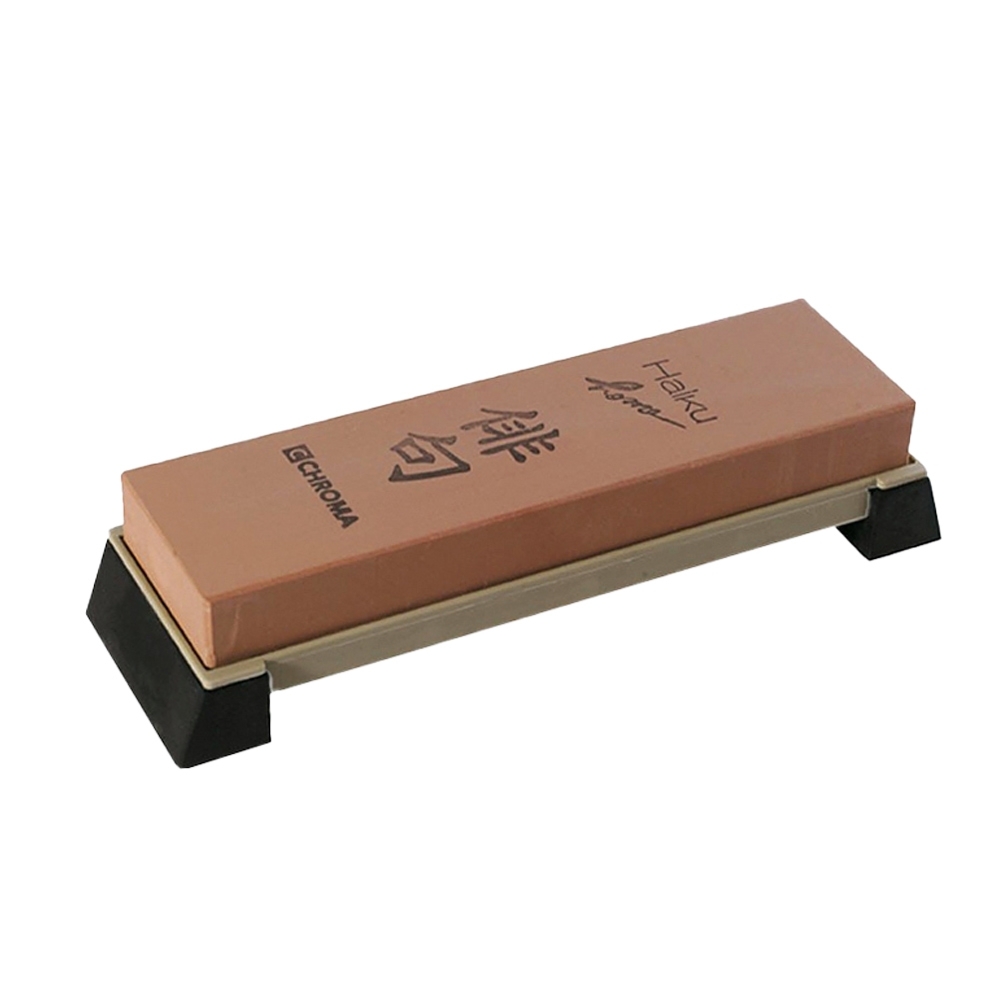
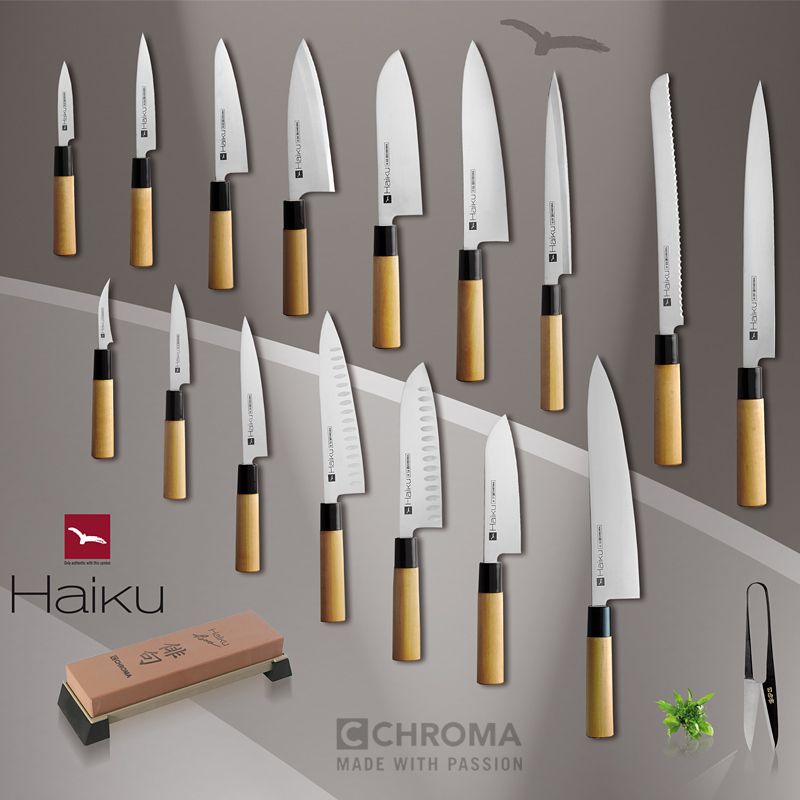
CHROMA Haiku Original - H-11 Whetstone 800 - Standard - For regular sharpening / maintenance of edge. 18 x 5 x 1,8 cm - 7" x 2" x 0,8" Grit: 800 with stand CHROMA HIGH GRADE WHETSTONES 200 - 240 - Pregrinding of dull knives or smaller repair 800 - 2000 - Standard – For regular sharpening / maintenance of edge. 3000 - 4000 - For perfect sharpness - for use after the 1000's 6000 - 12000 - Polishing – herewith the knife becomes ideal, for use after the 3000' Kitchen Knife Sharpening There are various types of waterstones & ceramic stones available and normally a medium grit stone is sufficient to start with. However, if the blade is blunt or damaged, it may be necessary to start with rough grit. There are several differences between waterstones and ceramic stones. A waterstone must be placed in water and allowed to soak for 10-15 minutes to allow it to absorb sufficient moisture. A ceramic stone also requires water, but only needs to soak in water for 3-5 minutes. A ceramic stone is harder than a waterstone, so it will sharpen your knives more quickly. A ceramic stone will last longer and will not develop valleys or grooves as easily as a waterstone. The stone should be soaked for the required amount of time before use. Hold the knife so that the blade meets the stone at a 10-15 degree angle, then push back and forth across the stone in smooth steady strokes maintaining the same angle. Maintaining the same angle is most important and you will know that you are maintaining the same angle from the sound the knife makes against the stone. If you are making the same sound with each stroke back and forth against the stone, you are maintaining the same angle. Repeat the stage above on both sides of the blade going from one side to the other until your knife is sharp and there are no burrs on either side. During sharpening a certain amount of wet powder will appear, but do not wash or wipe this residue and continue sharpening. Although this powder appears unsightly, it is this residue which sharpens the knives. After sharpening, your knives should be washed in hot water and then towel dried.


size: 18 cm/7" x 5 cm/2" x 2 cm/0,8" grit: 800 Care and proper use of a high-quality knife is always essential to maintain the best cutting edge and to insure the highest possible degree of safety when using. After all, a dull knife is a dangerous knife. The more pressure required to cut with a knife the greater chance of an accident occurring while it is being used. Kitchen Knife Sharpening There are various types of waterstones & ceramic stones available and normally a medium grit stone is sufficient to start with. However, if the blade is blunt or damaged, it may be necessary to start with rough grit. There are several differences between waterstones and ceramic stones. A waterstone must be placed in water and allowed to soak for 10-15 minutes to allow it to absorb sufficient moisture. A ceramic stone also requires water, but only needs to soak in water for 3-5 minutes. A ceramic stone is harder than a waterstone, so it will sharpen your knives more quickly. A ceramic stone will last longer and will not develop valleys or grooves as easily as a waterstone. The stone should be soaked for the required amount of time before use. Hold the knife so that the blade meets the stone at a 10-15 degree angle, then push back and forth across the stone in smooth steady strokes maintaining the same angle. Maintaining the same angle is most important and you will know that you are maintaining the same angle from the sound the knife makes against the stone. If you are making the same sound with each stroke back and forth against the stone, you are maintaining the same angle. Repeat the stage above on both sides of the blade going from one side to the other until your knife is sharp and there are no burrs on either side. During sharpening a certain amount of wet powder will appear, but do not wash or wipe this residue and continue sharpening. Although this powder appears unsightly, it is this residue which sharpens the knives. After sharpening, your knives should be washed in hot water and then towel dried.


IMPORTANT: Please download the attached document here, fill out the required information, and send it to us along with the knives you have selected and a copy of your order confirmation. A separate online order must be placed for each knife. Good knives always need a little care from time to time. Every knife loses its sharpness at some point, and what's more annoying and spoils the fun of cooking? Right. A blunt knife. In addition to high-quality knives, we also offer our own sharpening service. The knives are sharpened in the classic Japanese V-grind; a conversion from the German U-grind to a V-grind is possible. The knives are professionally hand-ground using wet whetstones with various grits – initially 240/1000 – and then polished to 3000/8000. Polishing preserves the knife's sharpness for longer when used correctly, and any open pores are closed. In many cases, depending on the steel used, the knife's sharpness is even sharper than when purchased new. If your knives have any damage, we can repair it to a certain extent. For example, broken tips or chipped blades. Please use our contact form or send an email directly with a picture of the damaged blade to: service@culinaris.eu Your knife will be assessed and a cost estimate will be prepared. We assume no liability for blades that have already been sent to us that are severely damaged or torn. Not every knife can be repaired; if in doubt, please contact us first. Service prices: Blades up to 15 cm long: €10.00 Blades over 15 cm long: €16.00 Turning knives with inwardly curved blades: €20.00 Repair of broken Knife tip under 5 mm: €3.00 Handle care for wooden knife handles: €2.00 Please note that the shipping costs incurred when ordering online cover the return shipping costs. Our services at a glance: Sharpening of all commercially available smooth blades with a Japanese V-grind Repair and repair of defective blades Restoration of broken knife tips under 5 mm Handle care for wooden handles Blade oil for non-stainless knives Serrated edges on request with longer processing time Please send your knife at your own expense to: Culinaris Logistics Center Steinbachweg 8 04158 Leipzig Grinding course Want to sharpen your knives yourself but aren't sure how? You can book a private sharpening course at our branches in Leipzig / Berlin / Günthersdorf / Erfurt and Hamburg. Bring a little time and a knife, and we'll take care of the rest. Prices upon request.


Güde - Sharpening steel 26 cm - Serie Alpha - Ideal for sharpening your Güde knife. Length: 26 cm Blade: high carbon-chromiumvanadium, stainless, icehardened, hand ground cutting edge. Handle: Hostaform, mirror polished. Quality - Made in Germany - Solingen. The Alpha Series knives begin as a single piece of specially alloyed Chrome-Vanadium-Moly cutlery steel. Each knife is hand forged and continues through more than thirty separate steps in the production process before completion. The finely polished grips are made from a robust, long-lasting plastic called Hostaform. Ice hardened stainless steel, hand sharpened and dishwasher safe! The Alpha Series knives are manufactured in accordance with the standards for use in restaurants and the food processing industry and offer the widest model range of any Güde Knife Series. Ice hardened stainless steel; hand sharpened – not for the dishwasher!

Güde - Sharpening steel 26 cm - Serie Kappa - Ideal for sharpening your Güde knife. Blade length: 26 cm Blade: high carbon-chromiumvanadium, stainless, icehardened, hand ground cutting edge. Quality - Made in Germany - Solingen. The Kappa Series knives begin as a single piece of specially alloyed Chrome-Vanadium-Moly cutlery steel. Each knife is hand forged and continues through more than thirty separate steps in the production process before completion. Each knife is fully stainless, ice hardened and dishwasher safe. The Kappa knives are crafted entirely of steel – including the grips – which gives these knives an ideal weight distribution and balance in the hand. Our traditional production process and the innovative design of the Kappa Series were acknowledged by the Red Dot Design Award


KASUMI Masterpiece - K-12 Ceramic Whetstone - Double-sided Whetstone - 3000/8000 incl. Shusei Toishi Grit 3000: For perfect sharpness Grit 8000: Polishing – herewith the knife becomes ideal 18 x 6 x 3 cm grit: 3000/8000 incl. Shusei Toishi with stand HIGH GRADE WHETSTONES 200 - 240 - Pregrinding of dull knives or smaller repair 800 - 2000 - Standard – For regular sharpening / maintenance of edge. 3000 - 4000 - For perfect sharpness - for use after the 1000's 6000 - 12000 - Polishing – herewith the knife becomes ideal, for use after the 3000' Kitchen Knife Sharpening There are various types of waterstones & ceramic stones available and normally a medium grit stone is sufficient to start with. However, if the blade is blunt or damaged, it may be necessary to start with rough grit. There are several differences between waterstones and ceramic stones. A waterstone must be placed in water and allowed to soak for 10-15 minutes to allow it to absorb sufficient moisture. A ceramic stone also requires water, but only needs to soak in water for 3-5 minutes. A ceramic stone is harder than a waterstone, so it will sharpen your knives more quickly. A ceramic stone will last longer and will not develop valleys or grooves as easily as a waterstone. The stone should be soaked for the required amount of time before use. Hold the knife so that the blade meets the stone at a 10-15 degree angle, then push back and forth across the stone in smooth steady strokes maintaining the same angle. Maintaining the same angle is most important and you will know that you are maintaining the same angle from the sound the knife makes against the stone. If you are making the same sound with each stroke back and forth against the stone, you are maintaining the same angle. Repeat the stage above on both sides of the blade going from one side to the other until your knife is sharp and there are no burrs on either side. During sharpening a certain amount of wet powder will appear, but do not wash or wipe this residue and continue sharpening. Although this powder appears unsightly, it is this residue which sharpens the knives. After sharpening, your knives should be washed in hot water and then towel dried. KASUMI MASTERPIECE Kasumi Masterpiece are a special, limited version of the Kasumi knife. They are the result of consistent further development, improvement, and decades of experience in the company Sumikama the blade forging. Kasumi Masterpiece knives are the best that ever. The Japanese character is the character of Kasumi Masterpiece knife. In its actual translation it means something like "masterful handiwork" (Takumi). Kasumi Masterpiece knives get your exceptional properties by the invaluable experience of the best masters and their hand, in connection with the use of modern technology - in the tradition of Japanese sword forging. The middle layer of the Kasumi Masterpiece blade is made of the best Japanese "VG10 Cobalt high carbon steel, which was developed exclusively for production of very high quality kitchen knives. After forging, the blades are again heated to about 800 ° C, then quickly cooled down and so hardened to about 59-60 ° C. Rockwell. The hardness of 59-60 HRC is not only in Japan for optimum hardness as kitchen knives. It allows for a very long service life of the cutting edge (sharpness), but also an equally easy re-sharpening the SUMIKAMA grindstone. The perfect, hot-flashing edge is the product of many grinding operations on rotating special water grinding stones. Only the best from Seki grinder grind each blade of Kasumi Masterpiece at various work steps by hand. Your final sharpness get the knife through the final grinding process with a fine 3000 Kasumi water stone. The Kasumi Masterpiece damask pattern on both sides of the blade, formed by repeated folding and forging of high-grade steel in several layers. The professional handle the Kasumi Masterpiece knives is made of a hard resin thermoset linen. By pressure and heat of this resin is replaced by his special life and so its good shape. The knife is very comfortable and secure in the hand. The beauty of the blade, along with the glossy finish handle - this knife is so unique. Kasumi Masterpiece are beautiful and extremely sharp, they are perfect for any type of preparation of fine cuisine. Kasumi knives are produced by Sumikama Cutlery in Seki, Japan. Sumikama Cutlery specializes in producing knives from very advanced materials with the most advanced manufacturing techniques.


The SKARPA knife sharpener is a versatile tool that meets all your sharpening needs. Thanks to its multifunctionality, you can use it to sharpen various types of blades, from straight-bladed knives to serrated bread knives and scissors. This makes it an extremely practical tool for any kitchen. Not only is the sharpener efficient at restoring a razor-sharp edge to your blades, but it is also durable and ensures long-lasting performance. All in all, this tool is a must-have for anyone who values sharp and efficient cutting tools. Knife sharpener with three sharpening stages for knives with straight blades (coarse grinding, honing, polishing) Separate slot for sharpening serrated knives and scissors Transparent cover, cleaning brush Ergonomic handle, non-slip silicone base With a grinding angle of 19° Material: ABS, stainless steel, PVC, silicone, diamond, carbide (tungsten), ceramic Dimensions: 21 x 5 x 7 cm Color: Black


The SKARPA knife sharpener is a versatile tool that will meet all your sharpening needs. Thanks to its multifunctionality, it allows you to sharpen various types of blades, from straight knives to serrated bread knives and scissors. This makes it an extremely practical tool for any kitchen. Not only is the sharpener efficient at restoring a razor-sharp edge to your blades, but it is also durable, ensuring long-lasting performance. Overall, this tool is a must-have for anyone who appreciates sharp and efficient cutting tools. Knife sharpener with three stages for sharpening plain blades (coarse grinding, honing, and polishing), as well as a serrated blade and scissor sharpener. Transparent cover, cleaning brush Ergonomic handle, non-slip silicone base With a grinding angle of 19° Material: ABS, stainless steel, PVC, silicone, diamond, hard metal (tungsten), ceramic Dimensions: 21 x 5 x 7 cm Color: Cream


The SKARPA PRO knife sharpener is a versatile tool that meets all your sharpening needs. Thanks to its multifunctionality, you can use it to sharpen various types of blades, from straight-bladed knives and different grinding angles to serrated knives and scissors. This makes it an extremely practical tool for any kitchen. The sharpener is not only efficient at restoring a razor-sharp blade, but also durable, ensuring long-lasting performance. Overall, this tool is a must-have for anyone who values sharp, efficient cutting tools. Knife sharpener with multiple angle settings Different grinding angles for knives with straight blades Fine grinding with automatic angle adjustment Angle settings: 15° for filleting knives and Asian kitchen knives 18/20° for European and American kitchen knives 22° for paring and boning knives 24° for butcher knives and outdoor knives. Separate slot for sharpening serrated knives and scissors. Material: Carbide (tungsten), resin, diamond, ABS, POM, silicone Dimensions: 26 x 4.7 x 8.4 cm

EUR 499.00 per liter for the care of knife blades has a smoothing effect without leaving a greasy film less resistance when cutting cleans protects against corrosion Application: Apply a very thin layer with a cloth and rub in. Term: Prunus armeniaca kernel oil, 10 ml, antibacterial, origin: China, light yellow, mildly scented, pressed from the kernels of sweet apricots The apricot tree probably originally comes from China and came to Italy in Roman times. Today it is cultivated in the Mediterranean region, in Turkey, in Eastern Europe as well as in the USA, Canada, South Africa, Australia and New Zealand. The fruit kernels contain approx. 40-50% light yellow, mildly scented oil, which is not only used cosmetically but is also valued as a fine edible oil when it is pressed from the kernels of the sweet apricot. Apricot kernel oil used cosmetically comes primarily from the bitter kernels of wild apricots. Prunus Armeniaca Kernel Oil is the fixed oil pressed from kernels of apricot, Prunus armeniaca, Rosaceae. It consists mainly of fatty acid glycerides.
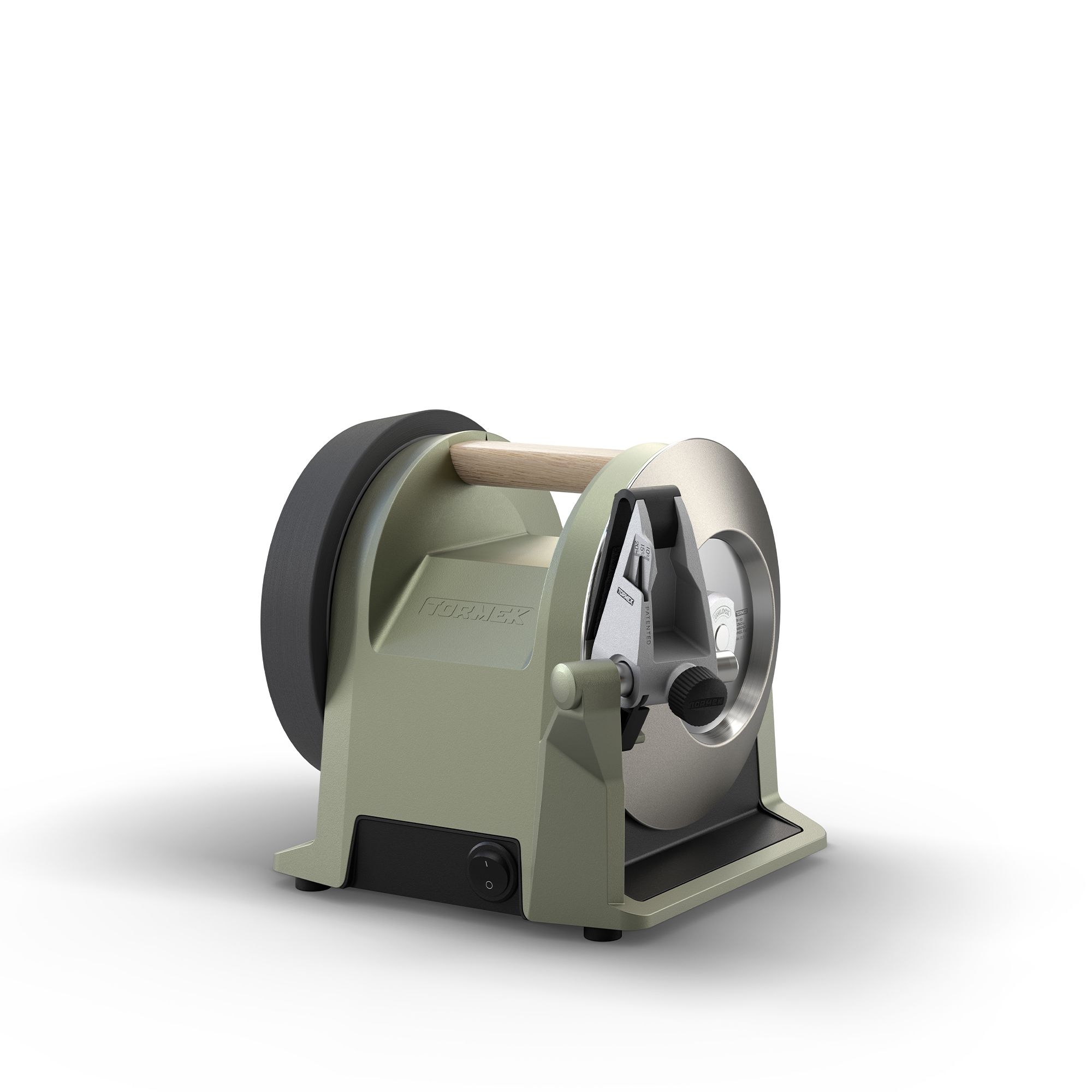
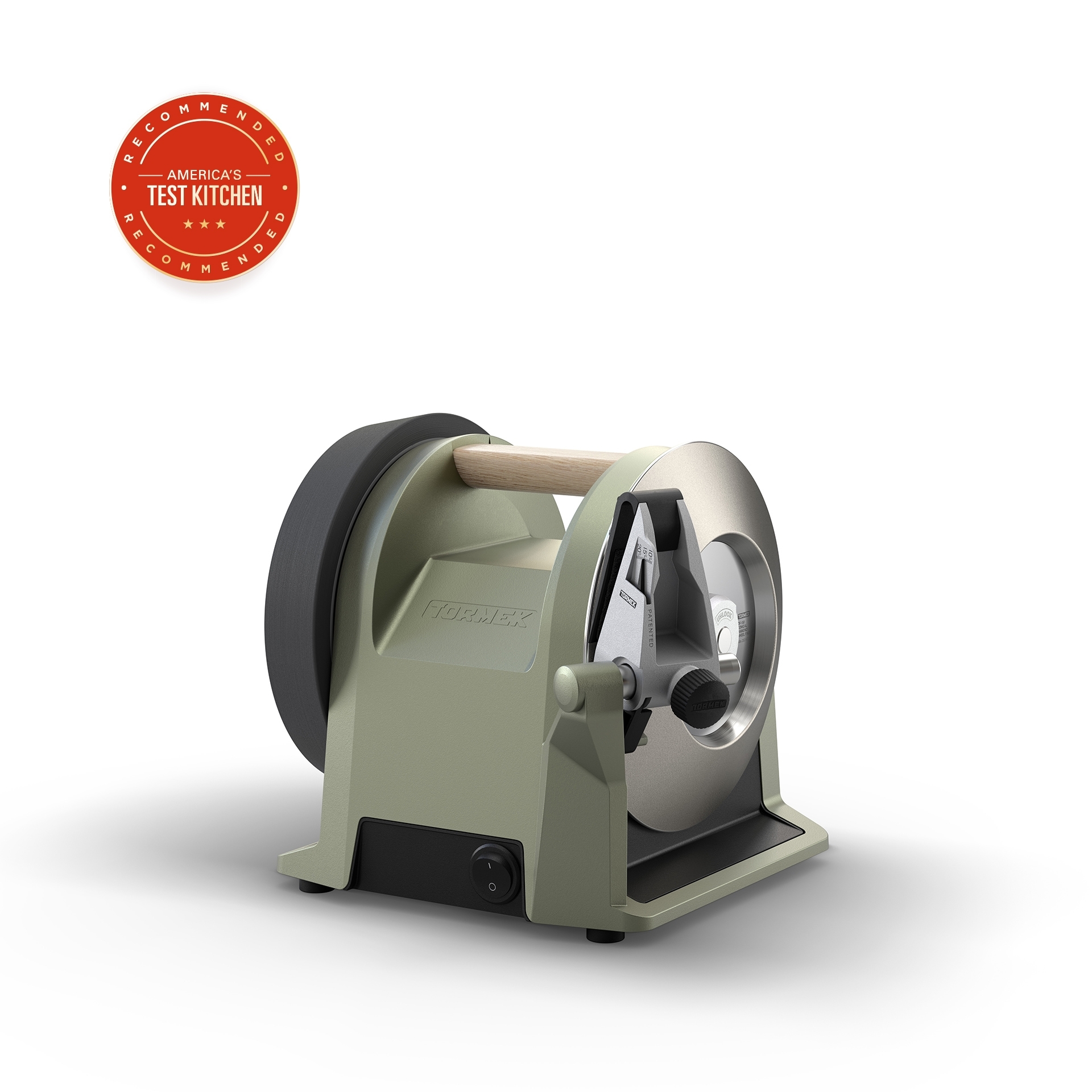
The Tormek T-1 Kitchen Knife Sharpener is the best choice for amateur chefs when it comes to electric knife sharpeners. Unlike a simpler sharpener, a hand sharpener or a whetstone, the entire grinding phase of the knife is sharpened and not just the outer part of the cutting edge. Thanks to the patented guide, the grinding angle can be easily and precisely adjusted between 8 and 22 degrees. With the Tormek T-1 Kitchen Knife Sharpener you never have to have your knives sharpened outside the home again, but can simply sharpen them professionally in your own kitchen in just a few minutes. Tormek brand products are shipped exclusively within Germany. Delivery to other countries is not possible. Precise adjustment of the grinding angle with patented guide. For knives with blade widths of 12 - 60 mm and a thickness of up to 5 mm Grinding angle adjustable between 8 - 22 degrees on each side Housing made of precision die-cast zinc, powder-coated, base made of impact-resistant plastic, wooden handle made of solid Ash, treated with hard wax oil Cable length: 1.7 m Grinding wheel: DF-150 Conical Diamond Wheel Fine (600 grit), dimensions: Ø 150 x 18 mm Pulling wheel: PW-160 Conical composite pulling wheel Composite, ABS plastic, dimensions: Ø 160 x 30 mm Single-phase AC motor Input power: idle 60W, max. load 120W, 100-115 V / 220-240 V, 50-60 Hz Maintenance-free, smooth running, 45 dB Color: Ash Green Power: 150 rpm, torque 2 Nm Plug type: E+F Dimensions: 20.4 x 19.6 x 18.1 cm Unbalance of the grinding or honing wheel: If an imbalance occurs, try turning the diamond wheel and the honing wheel once against each other. This is a left-hand thread and no tool is required. Then turn the honing wheel a little and then tighten it again with a little momentum. As a general rule: Due to the low rotational speed, even a small unevenness or imbalance in the honing wheel looks relatively dramatic. However, this is often within the tolerance and has no influence on handling or the result. Rattling noises during operation: When the machine is delivered or has been stationary for some time, the motor shaft can leave an imprint on the drive wheel of the machine. This can lead to a recurring knocking/clacking noise. This is normal and will disappear after some time of use. It has no influence on the machine or the result.
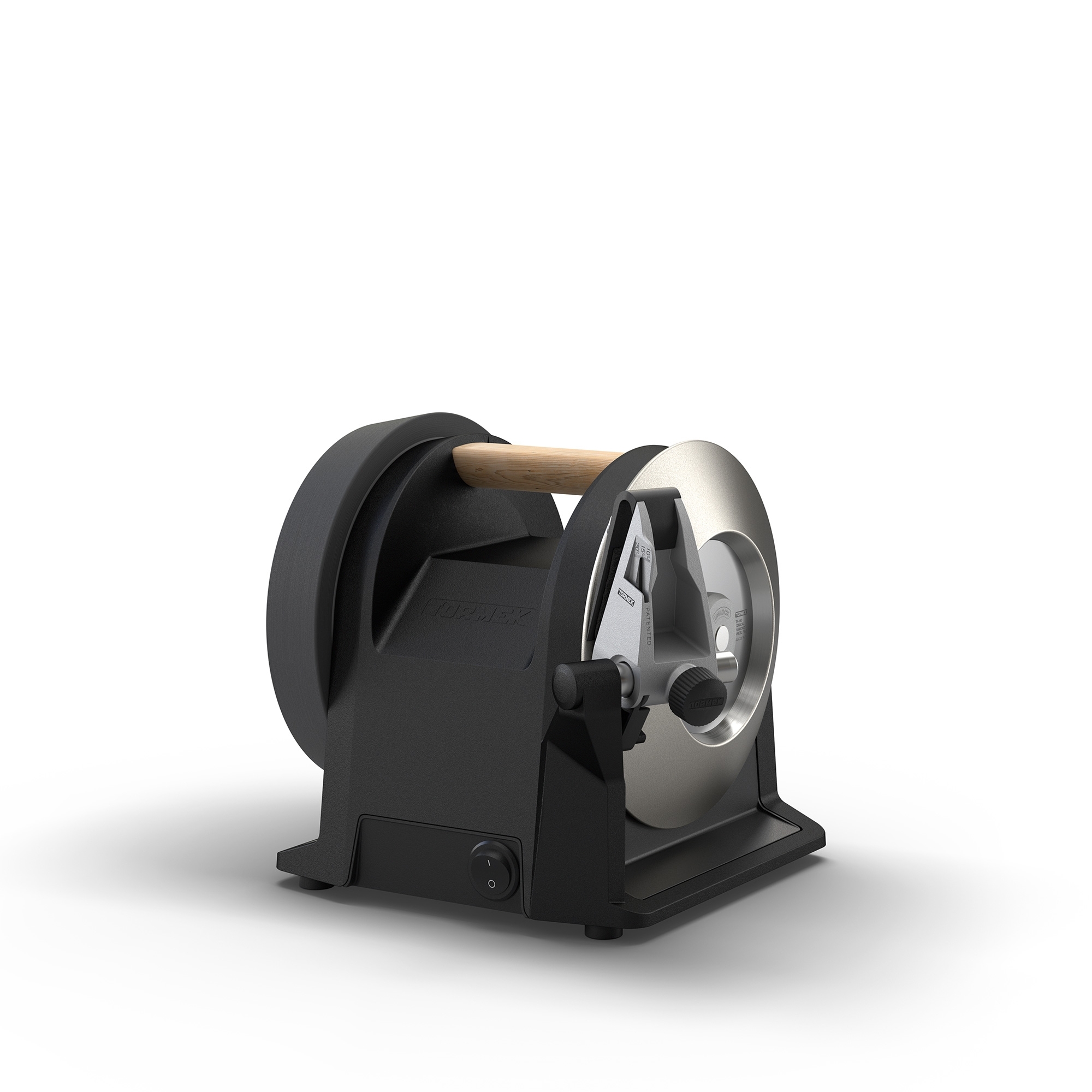
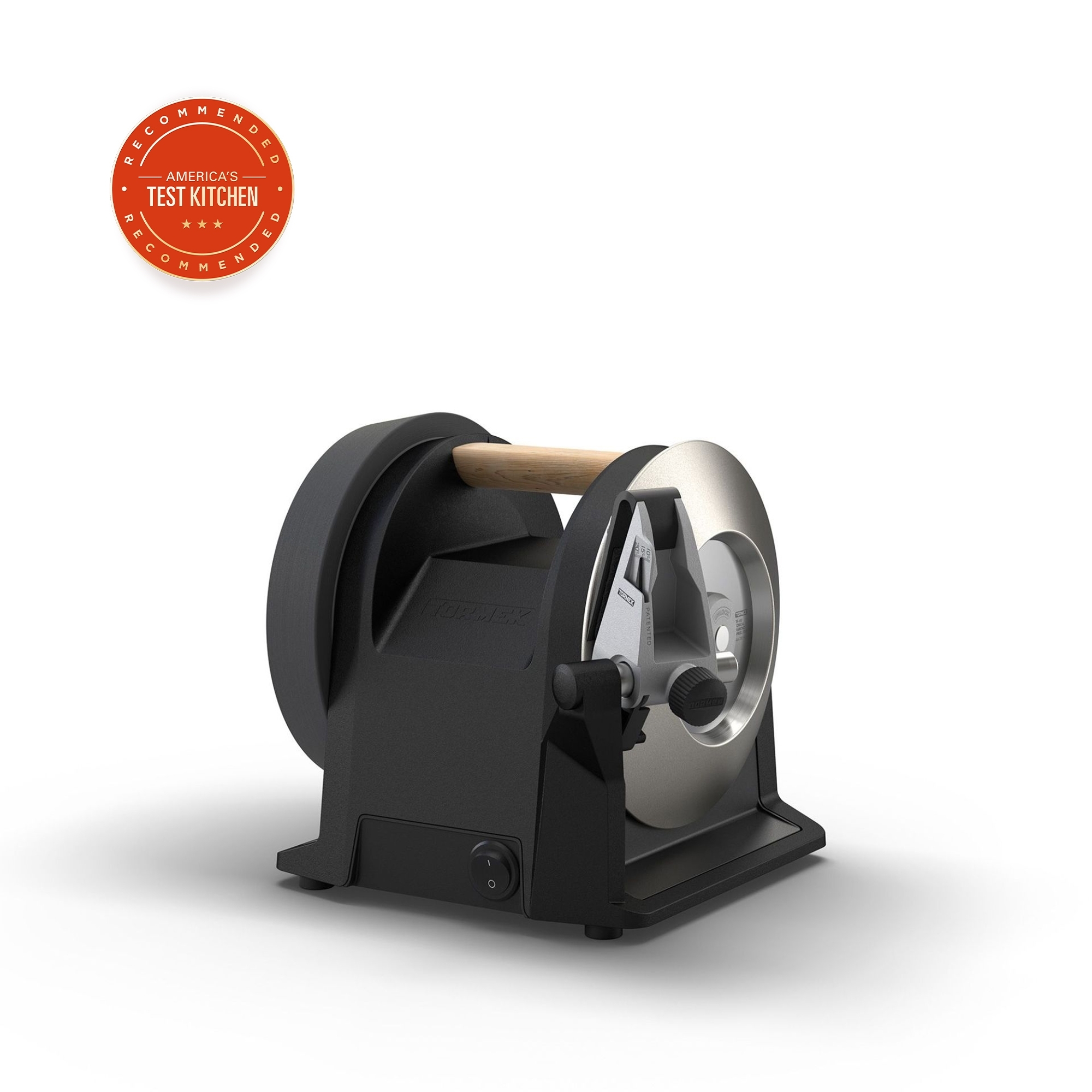
The Tormek T-1 Kitchen Knife Sharpener is the best choice for amateur chefs when it comes to electric knife sharpeners. Unlike a simpler sharpener, a hand sharpener or a whetstone, the entire grinding phase of the knife is sharpened and not just the outer part of the cutting edge. Thanks to the patented guide, the grinding angle can be easily and precisely adjusted between 8 and 22 degrees. With the Tormek T-1 Kitchen Knife Sharpener you never have to have your knives sharpened outside the home again, but can simply sharpen them professionally in your own kitchen in just a few minutes. Tormek brand products are shipped exclusively within Germany. Delivery to other countries is not possible. Precise adjustment of the grinding angle with patented guide. For knives with blade widths of 12 - 60 mm and a thickness of up to 5 mm Grinding angle adjustable between 8 - 22 degrees on each side Housing made of precision die-cast zinc, powder-coated, base made of impact-resistant plastic, wooden handle made of solid oak, treated with hard wax oil Cable length: 1.7 m Grinding wheel: DF-150 Conical Diamond Wheel Fine (600 grit), dimensions: Ø 150 x 18 mm Pulling wheel: PW-160 Conical composite pulling wheel Composite, ABS plastic, dimensions: Ø 160 x 30 mm Single-phase AC motor Input power: idle 60W, max. load 120W, 100-115 V / 220-240 V, 50-60 Hz Maintenance-free, smooth running, 45 dB Color: Carbon Black Power: 150 rpm, torque 2 Nm Plug type: E+F Dimensions: 20.4 x 19.6 x 18.1 cm Unbalance of the grinding or honing wheel: If an imbalance occurs, try turning the diamond wheel and the honing wheel once against each other. This is a left-hand thread and no tool is required. Then turn the honing wheel a little and then tighten it again with a little momentum. As a general rule: Due to the low rotational speed, even a small unevenness or imbalance in the honing wheel looks relatively dramatic. However, this is often within the tolerance and has no influence on handling or the result. Rattling noises during operation: When the machine is delivered or has been stationary for some time, the motor shaft can leave an imprint on the drive wheel of the machine. This can lead to a recurring knocking/clacking noise. This is normal and will disappear after some time of use. It has no influence on the machine or the result.


The Tormek T-1 Kitchen Knife Sharpener is the best choice for amateur chefs when it comes to electric knife sharpeners. Unlike a simpler sharpener, a hand sharpener or a whetstone, the entire grinding phase of the knife is sharpened and not just the outer part of the cutting edge. Thanks to the patented guide, the grinding angle can be easily and precisely adjusted between 8 and 22 degrees. With the Tormek T-1 Kitchen Knife Sharpener you never have to have your knives sharpened outside the home again, but can simply sharpen them professionally in your own kitchen in just a few minutes. Tormek brand products are shipped exclusively within Germany. Delivery to other countries is not possible. Precise adjustment of the grinding angle with patented guide. For knives with blade widths of 12 - 60 mm and a thickness of up to 5 mm Grinding angle adjustable between 8 - 22 degrees on each side Housing made of precision die-cast zinc, powder-coated, base made of impact-resistant plastic, wooden handle made of solid birch, treated with hard wax oil Cable length: 1.7 m Grinding wheel: DF-150 Conical Diamond Wheel Fine (600 grit), dimensions: Ø 150 x 18 mm Pulling wheel: PW-160 Conical composite pulling wheel Composite, ABS plastic, dimensions: Ø 160 x 30 mm Single-phase AC motor Input power: idle 60W, max. load 120W, 100-115 V / 220-240 V, 50-60 Hz Maintenance-free, smooth running, 45 dB Color: Swedish Red Power: 150 rpm, torque 2 Nm Plug type: E+F Dimensions: 20.4 x 19.6 x 18.1 cm Unbalance of the grinding or honing wheel: If an imbalance occurs, try turning the diamond wheel and the honing wheel once against each other. This is a left-hand thread and no tool is required. Then turn the honing wheel a little and then tighten it again with a little momentum. As a general rule: Due to the low rotational speed, even a small unevenness or imbalance in the honing wheel looks relatively dramatic. However, this is often within the tolerance and has no influence on handling or the result. Rattling noises during operation: When the machine is delivered or has been stationary for some time, the motor shaft can leave an imprint on the drive wheel of the machine. This can lead to a recurring knocking/clacking noise. This is normal and will disappear after some time of use. It has no influence on the machine or the result.


The DC-150 ‘Coarse’ conical diamond wheel is a coarse diamond wheel with a grit size of 360. It is ideal for sharpening very blunt knives, repairing damaged cutting edges and restoring worn knife tips. The grinding disc is easy to fit and has been specially developed for the Tormek T-1 kitchen sharpener. It works in conjunction with the machine’s angle guide, enabling controlled sharpening. Thanks to its coarse surface, material is removed more quickly than with the standard grinding disc, making it easier to repair heavily worn or damaged kitchen knives. Replacement grinding wheel for the Tormek T-1 Knife Sharpener 360 grit Lasts for more than a thousand sharpening passes Suitable only for the Tormek T-1 Kitchen Knife Sharpener Diameter: 15 cm Width: 1.8 cm Material: Steel with diamond coating
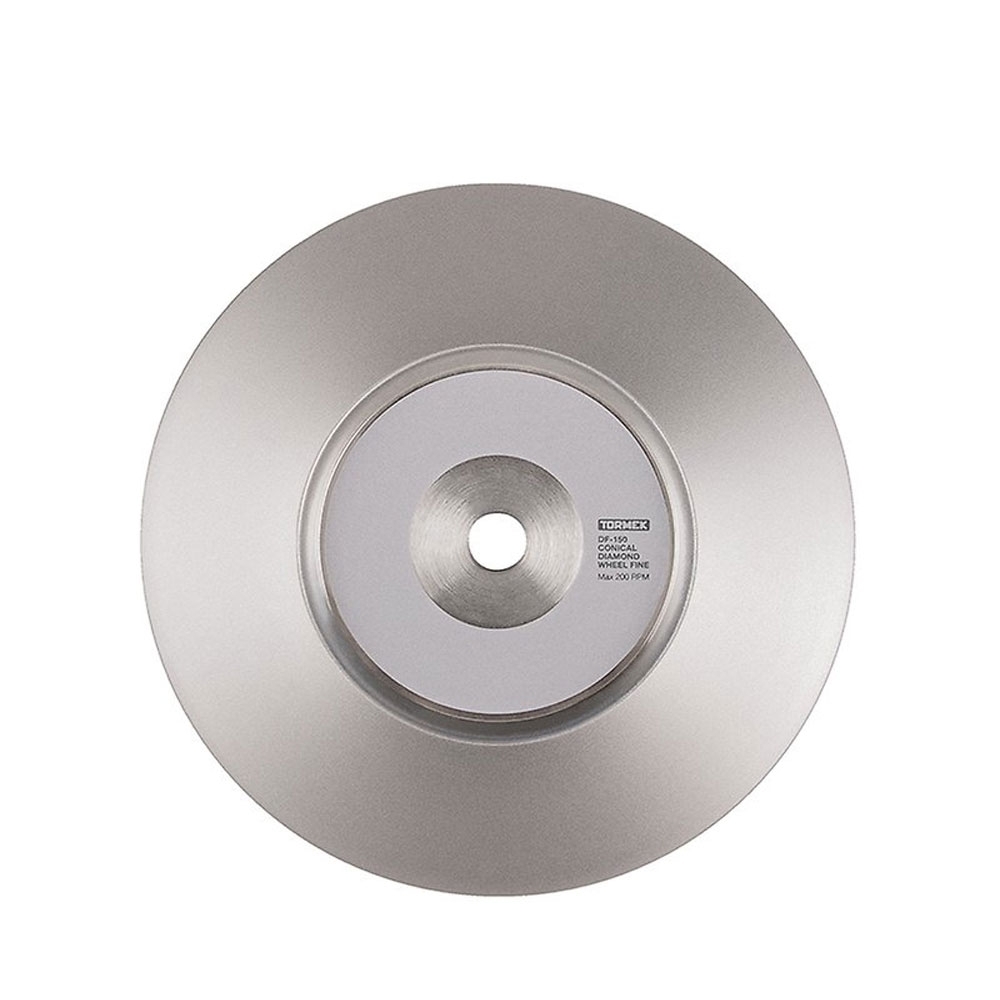
The DF-150 Conical Diamond Wheel Fine from Tormek comes standard with the Tormek T-1 Kitchen Knife Sharpener. If the diamond grinding wheel becomes damaged or worn, it can be replaced with a new one. Tormek brand products are shipped exclusively within Germany. Delivery to other countries is not possible. Replacement grinding wheel for the Tormek T-1 Knife Sharpener 600 grit Lasts for more than a thousand grinding cycles Only suitable for the Tormek t-1 Kitchen knife Sharpener Diameter: 15 cm Width: 1.8 cm Material: Steel with diamond coating


Replacement magnet for the Tormek T-1 Kitchen Knife Sharpener. It attracts the grinding dust produced during sharpening and ensures a clean workspace. Diameter: 2 cm
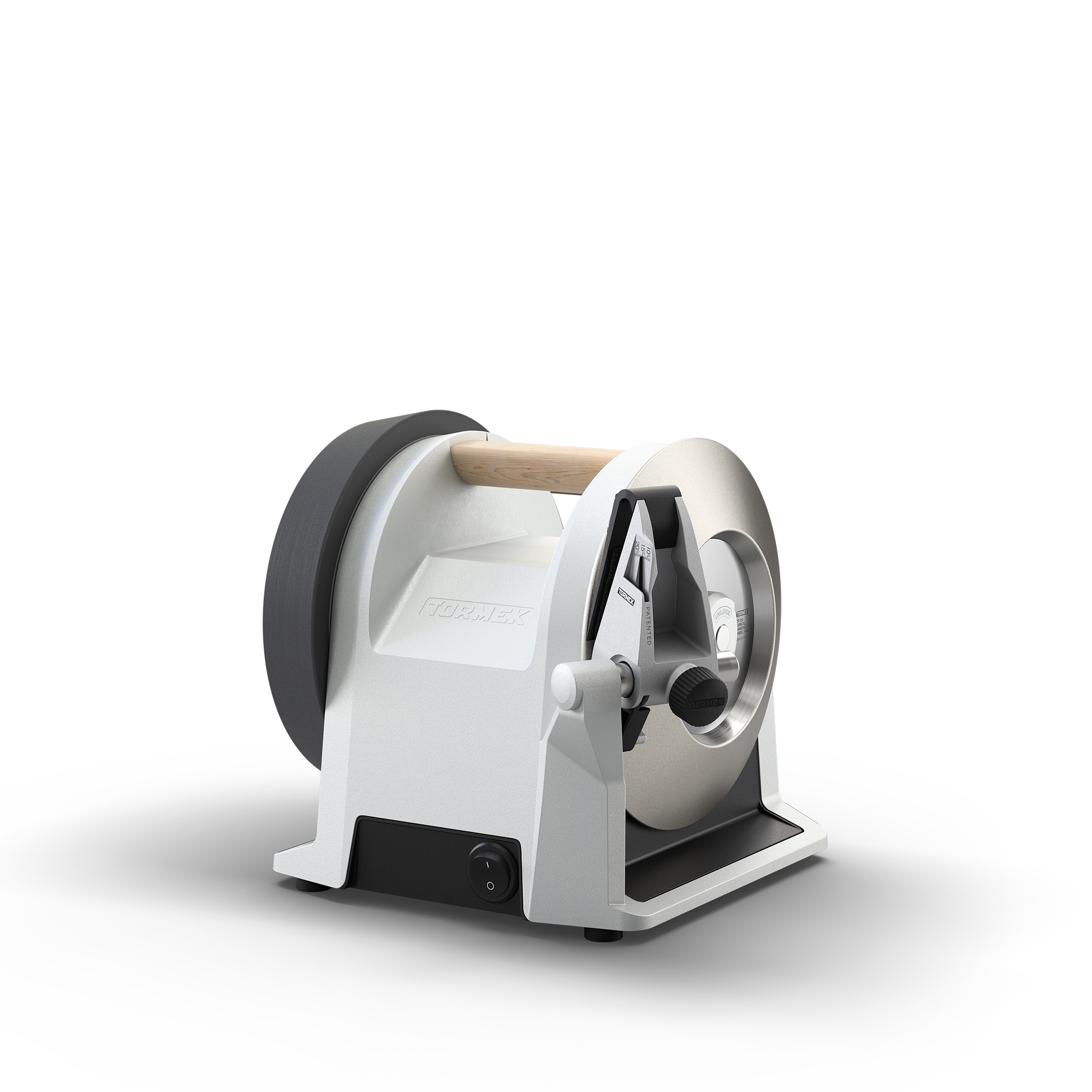
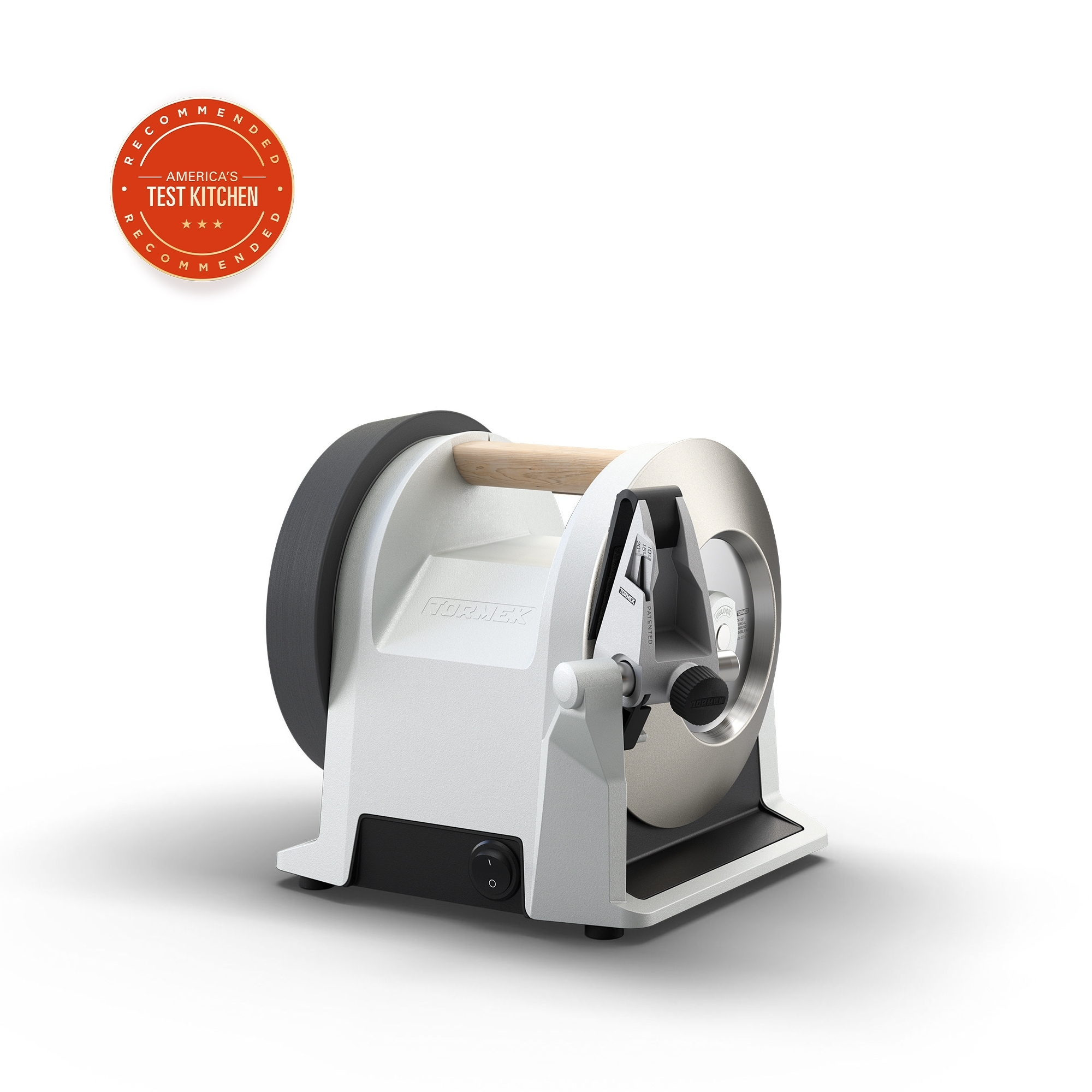
The Tormek T-1 Kitchen Knife Sharpener is the best choice for amateur chefs when it comes to electric knife sharpeners. Unlike a simpler sharpener, a hand sharpener or a whetstone, the entire grinding phase of the knife is sharpened and not just the outer part of the cutting edge. Thanks to the patented guide, the grinding angle can be easily and precisely adjusted between 8 and 22 degrees. With the Tormek T-1 Kitchen Knife Sharpener you never have to have your knives sharpened outside the home again, but can simply sharpen them professionally in your own kitchen in just a few minutes. Tormek brand products are shipped exclusively within Germany. Delivery to other countries is not possible. Precise adjustment of the grinding angle with patented guide. For knives with blade widths of 12 - 60 mm and a thickness of up to 5 mm Grinding angle adjustable between 8 - 22 degrees on each side Housing made of precision die-cast zinc, powder-coated, base made of impact-resistant plastic, wooden handle made of solid oak, treated with hard wax oil Cable length: 1.7 m Grinding wheel: DF-150 Conical Diamond Wheel Fine (600 grit), dimensions: Ø 150 x 18 mm Pulling wheel: PW-160 Conical composite pulling wheel Composite, ABS plastic, dimensions: Ø 160 x 30 mm Single-phase AC motor Input power: idle 60W, max. load 120W, 100-115 V / 220-240 V, 50-60 Hz Maintenance-free, smooth running, 45 dB Color: Zinc Gray Power: 150 rpm, torque 2 Nm Plug type: E+F Dimensions: 20.4 x 19.6 x 18.1 cm Unbalance of the grinding or honing wheel: If an imbalance occurs, try turning the diamond wheel and the honing wheel once against each other. This is a left-hand thread and no tool is required. Then turn the honing wheel a little and then tighten it again with a little momentum. As a general rule: Due to the low rotational speed, even a small unevenness or imbalance in the honing wheel looks relatively dramatic. However, this is often within the tolerance and has no influence on handling or the result. Rattling noises during operation: When the machine is delivered or has been stationary for some time, the motor shaft can leave an imprint on the drive wheel of the machine. This can lead to a recurring knocking/clacking noise. This is normal and will disappear after some time of use. It has no influence on the machine or the result.
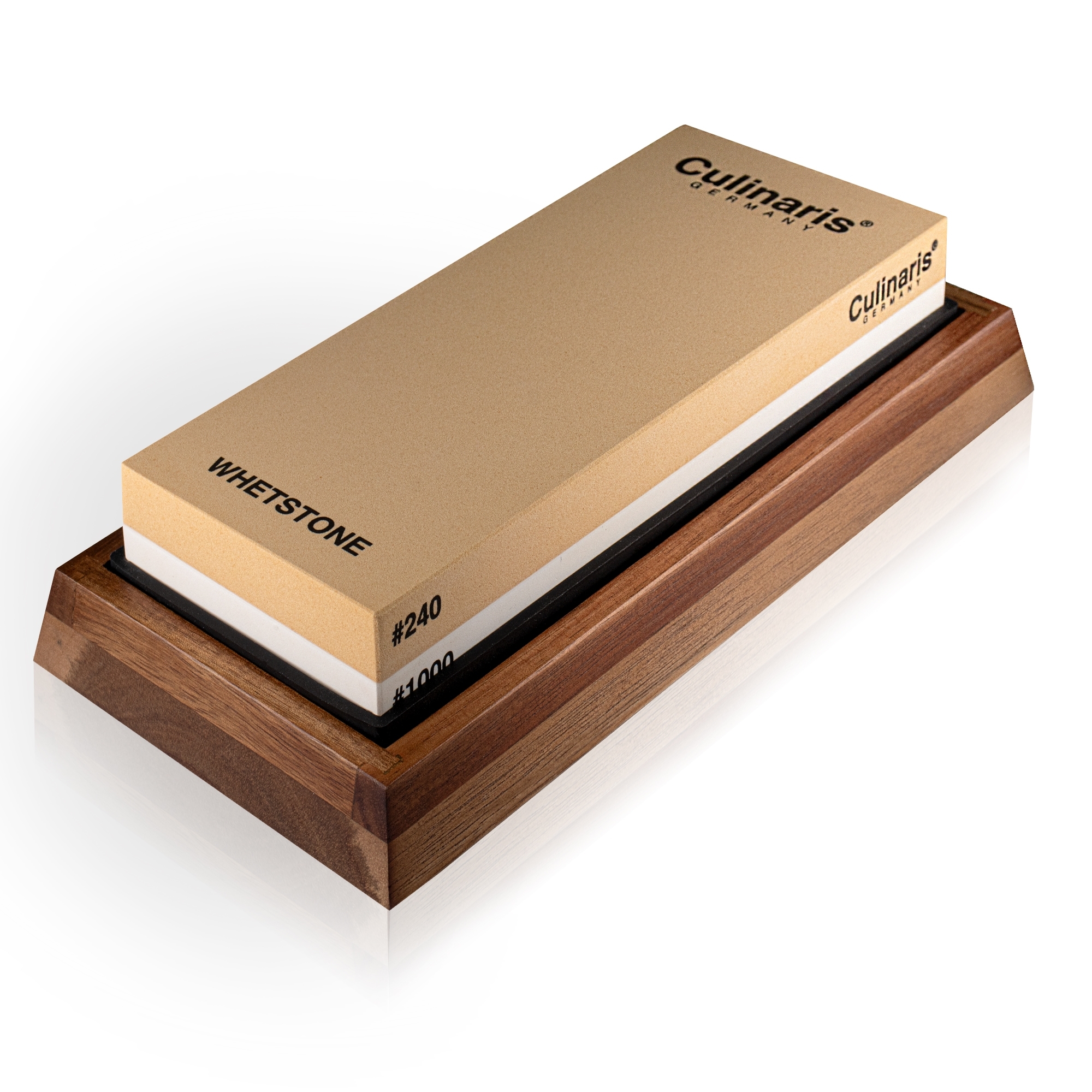
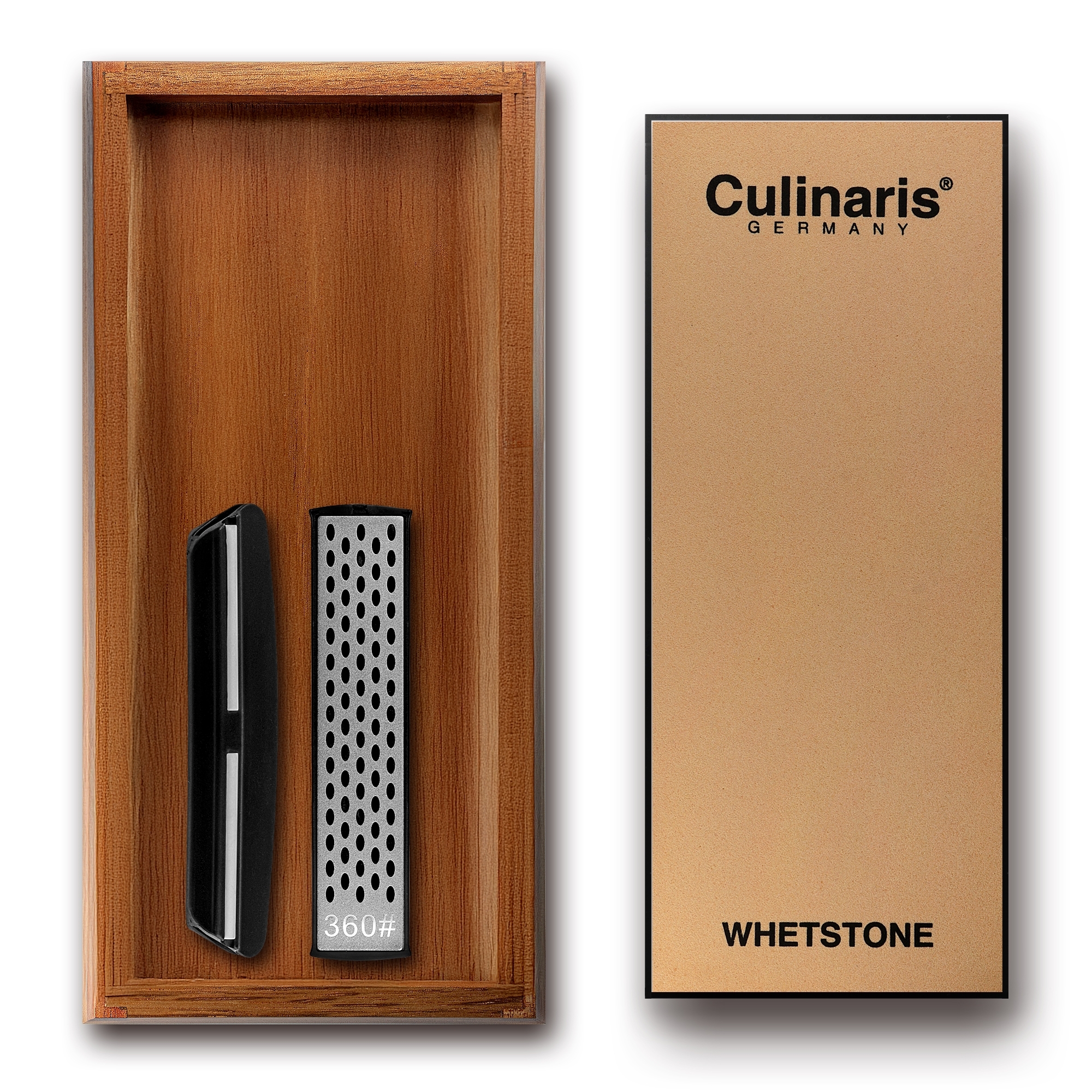
Whether you are a professional chef or an amateur gourmet, with the Culinaris whetstones you will always achieve optimum results and perfect sharpening of your knives. All knives become blunt over time. With the Culinaris whetstone, however, you can counteract this development. The whetstone enables both coarse and fine sharpening and is easy to use. This ensures that your blades continue to glide smoothly through ripe tomatoes or that onions still look appetising when chopping. USE OF THE GRIT SIZES 240: Pre-grinding of very blunt knives or minor repairs 1000: Standard, every knife should be sharpened regularly with this CONTENTS: Wet grindstone Dimensions: 8 x 20 x 3 cm Grit: 240 / 1000 Material: White fused aluminium Grinding stone rest Dimensions: 10.5 x 20.3 x 2.6 cm With non-slip mat on the base Material: acacia wood, silica gel Angle guide Dimensions: 10.0 x 2.0 x 1.6 cm Ensures a 15° sanding angle Sharpening stone flattener Dimensions: 10.5 x 2.5 x 2.2 cm For straightening the surface of the whetstone Diamond grinding surface Material: plastic, metal SANDING INSTRUCTIONS 1. place the stone in water for 10 minutes so that it is completely soaked. 2. the knife should be at an angle of 10-20 degrees to the whetstone. 3. the stone should always be wet during the sharpening process. 4. pull the knife over the stone by pushing it forwards and backwards with light pressure. 5. rinse the knife with lukewarm water after the sharpening process.


Whether you are a professional chef or an amateur gourmet, with the Culinaris sharpening stones you will always achieve optimum results and perfect sharpening of your knives. This knife sharpener is designed for knives that still have a good basic sharpness and only need a fine sharpening. The Culinaris whetstone is a high-quality tool that enables precise sharpening and therefore guarantees optimum performance. USE OF THE GRIT SIZES 3000: For perfect sharpness, to be used after the 1000 grindstone 8000: Polishing - the knife receives the perfect polish, to be used after the 3000 grit whetstone CONTENTS: Wet grindstone Dimensions: 8 x 20 x 3 cm Grit: 3000 / 8000 Material: White fused aluminium Grinding stone rest Dimensions: 10.5 x 20.3 x 2.6 cm With non-slip mat on the base Material: acacia wood, silica gel Angle guide Dimensions: 10.0 x 2.0 x 1.6 cm Ensures a 15° sanding angle Sharpening stone flattener Dimensions: 10.5 x 2.5 x 2.2 cm For straightening the surface of the whetstone Diamond grinding surface Material: plastic, metal SANDING INSTRUCTIONS 1. place the stone in water for 10 minutes so that it is completely soaked. 2. the knife should be at an angle of 10-20 degrees to the whetstone. 3. the stone should always be wet during the sharpening process. 4. pull the knife over the stone by pushing it forwards and backwards with light pressure. 5. rinse the knife with lukewarm water after the sharpening process.
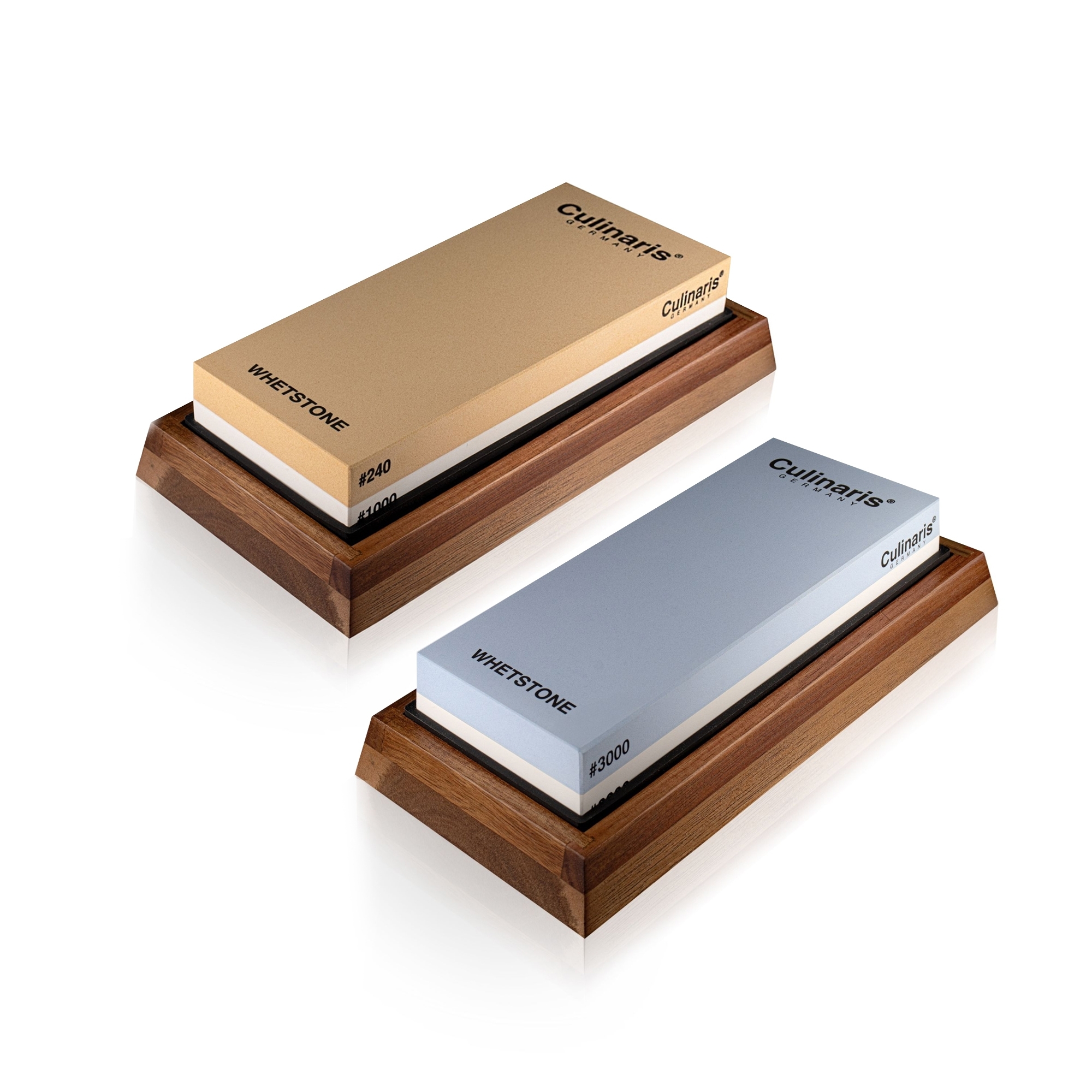
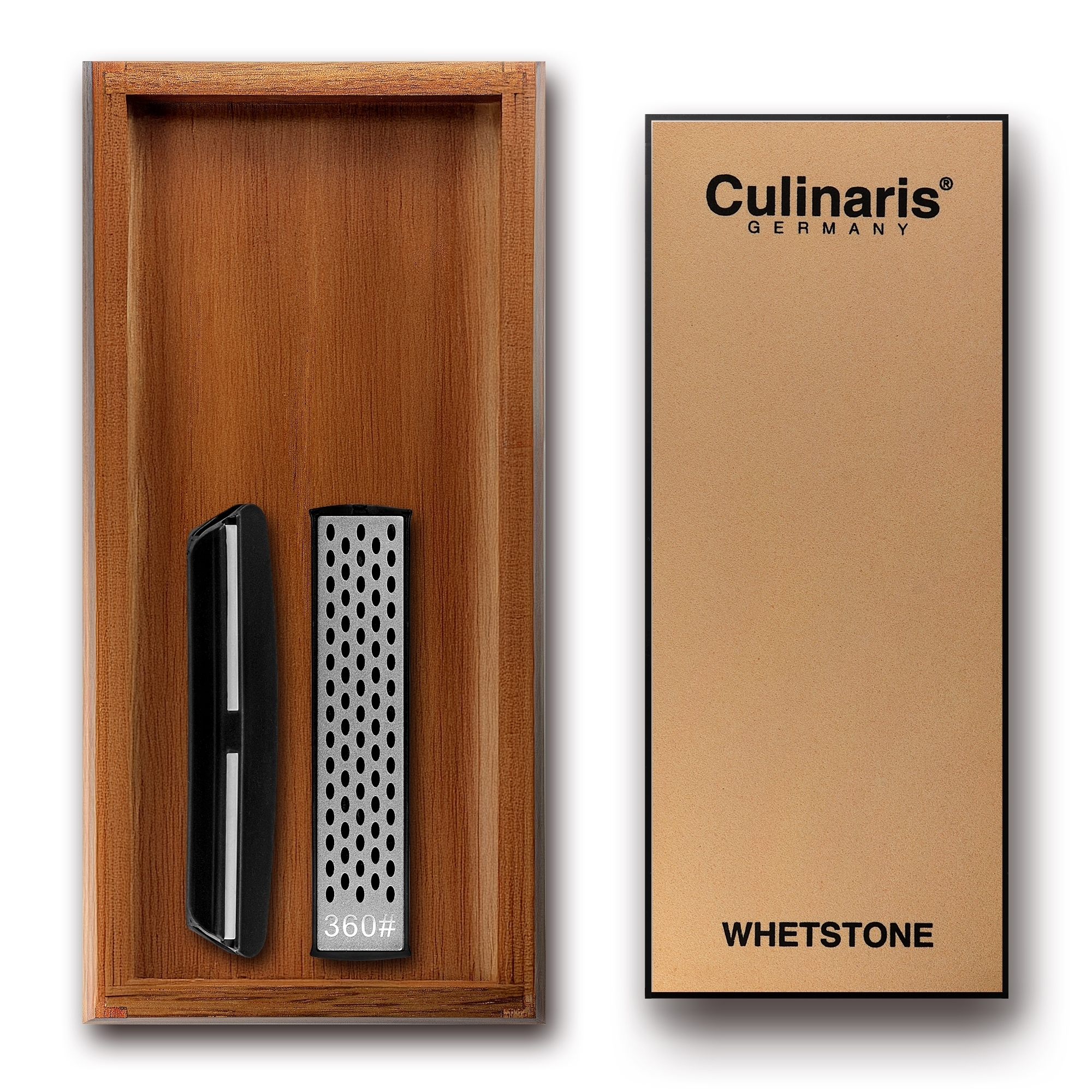
Whether you're a professional chef or a hobby gourmet, with Culinaris whetstones you'll always achieve optimal results and perfectly sharpen your knives. All knives become blunt over time. However, with Culinaris whetstones you can counteract this development. The set of two wet whetstones allows for both coarse and fine sharpening and is impressively easy to use. This ensures that your blades continue to glide smoothly through ripe tomatoes or that onions still look appetizing when chopped. USING THE GRITS 240: Pre-sharpening of very blunt knives or minor repairs 1000: Standard, every knife should be sharpened regularly with this grit 3000: For perfect sharpness, use after the 1000 grit whetstone 8000: Polish - the knife receives the perfect polish, use after the 3000 grit whetstone The set includes: Wet whetstone 240/1000 Dimensions: 8 x 20 x 3 cm Grit: 240 / 1000 Material: White Fused Alumina Wet Whetstone 3000/8000 Dimensions: 8 x 20 x 3 cm Grit: 240 / 1000 Material: White Fused Alumina Each whetstone comes with a whetstone rest, a grinding aid, and a whetstone straightener. Want to sharpen your knives yourself but aren't sure how? You can book a private sharpening course at our branches in Leipzig/Berlin/Günthersdorf/Erfurt and Hamburg. You bring a little time and a knife, we'll take care of the rest. Prices upon request. Or are you still looking for an unusual gift for friends or family? How about a knife sharpening course at Culinaris? Perfect for anyone who enjoys sharpening at home. SHARPENING INSTRUCTIONS 1. Place the stone in water for 10 minutes to allow it to fully absorb the water. 2. The knife should be at an angle of 10-20 degrees to the whetstone. 3. The stone should always be wet during the sharpening process. 4. Pull the knife across the stone by pushing it back in front of you with light pressure. 5. Rinse the knife with lukewarm water after sharpening.


The knife sharpener TWINSHARP by ZWILLING ensures a consistently sharp blade with regular use. To sharpen, simply insert the blade near the handle and pull it through to the tip with pressure. The TWINSHARP features two modules: The first slot contains stainless steel discs for coarse sharpening, which gently remove minor damage from the blade. After that, the blade can be pulled through the second module: The ceramic discs provide fine sharpening and, with regular use, can prevent dullness without the need for the first module. With its preset angle, the knife sharpener from ZWILLING is the perfect tool for professionals as well as beginners who are not yet ready to use a honing steel or sharpening stone. Stainless steel discs for coarse sharpening of damaged blades Ceramic discs for regular resharpening or fine sharpening Rubber feet for a non-slip and secure base Non-slip handle with finger guard for easy and safe handling Suitable for both right- and left-handed users Suitable for all knives with a smooth edge Dimensions (LxWxH): 8.3 x 4.7 x 8 cm Dishwasher safe The white ZWILLING symbol on a red background today represents a sophisticated lifestyle. Whether high-quality kitchen knives, kitchen products, or cutlery: the unique success of one of the world's oldest brands is based on customer satisfaction that transcended borders early on. With innovative products that continue to set international standards, ZWILLING consistently aligns with the desires of its customers.


Anyone who has cooked with a truly sharp knife knows the fascination of handling it. But even the best blade loses sharpness over time. To maintain quality in the long term, regular sharpening is essential. The ZWILLING V-Edge knife sharpener takes care of professional resharpening for you. Its patented sharpening mechanism is extremely simple yet absolutely effective. Professional knife sharpener Excellent and reliable sharpening results Easy to use Interchangeable angle adapters for European and Japanese blades 2 x 2 different sharpening rods with varying grit levels Modern design in silver/black Dimensions: approx. 21 cm x 20 cm x 8 cm To sharpen the blade, simply pull it diagonally from top to bottom – the V-Edge takes care of the rest. The V-shaped ceramic sharpening rods ensure the entire blade is evenly sharpened without the risk of damage. For European and Japanese knives, there are 2 x 2 interchangeable angle adapters. The adapter not currently in use can be conveniently stored in the base of the V-Edge. The professional sharpening rods with varying grit levels can be quickly replaced with just a few simple steps. To make it clear at first glance how good the V-Edge is, great emphasis has been placed on exceptional design and high-quality workmanship. Instead of storing it in a cupboard, leave it on the kitchen counter. This way, you can quickly run your knives through the V-Edge with fine grit before each use. Your knives will always have a professional edge, making cooking even more enjoyable. The white ZWILLING symbol on a red background today represents a sophisticated lifestyle. Whether high-quality kitchen knives, kitchen products, or cutlery: the unique success of one of the world's oldest brands is based on customer satisfaction that transcended borders early on. With innovative products that continue to set international standards, ZWILLING consistently aligns with the desires of its customers.


The sharpening steel by ZWILLING features a blade made of ridged, highly carbonized and hard-chromed steel. Its length of 21 cm allows for quick and powerful sharpening of various knives. The ridged surface helps achieve optimal results when sharpening blades. Additionally, the high-quality steel is durable and long-lasting. The black plastic handle ensures a secure grip while sharpening kitchen knives, scissors, and other blades. The rounded shape, non-slip surface, and the protective edge before the sharpening steel itself prevent fingers from slipping during sharpening. There is a hole at the end of the handle for hanging the tool. Using the sharpening steel extends the life of your knives, as rubbing the blade against the steel re-sharpens it, significantly improving cutting performance. With the practical sharpening tool from ZWILLING, your knives will glide effortlessly through meat, vegetables, and other ingredients you need to chop while preparing delicious meals. Sharpening steels made of ridged, highly carbonized, and hard-chromed steel ensure effective sharpening results. With a hardness of approximately 62 Rockwell, these sharpening steels are relatively resistant to damage. Plastic handle with a hanging loop. Length: 21 cm The white ZWILLING symbol on a red background today represents a sophisticated lifestyle. Whether high-quality chef’s knives, kitchen products, or cutlery: The unique success of one of the world’s oldest brands is based on customer satisfaction that crossed borders early on. With innovative products that continue to set international standards, they have always been aligned with customer desires.


The sharpening steel by ZWILLING features a blade made of ridged, highly carbonized and hard-chromed steel. Its length of 23 cm allows for quick and powerful sharpening of various knives. The ridged surface helps achieve optimal results when sharpening blades. Additionally, the high-quality steel is durable and long-lasting. The black plastic handle ensures a secure grip while sharpening kitchen knives, scissors, and other blades. The rounded shape, non-slip surface, and the protective edge before the sharpening steel itself prevent fingers from slipping during sharpening. There is a hole at the end of the handle for hanging the tool. Using the sharpening steel extends the life of your knives, as rubbing the blade against the steel re-sharpens it, significantly improving cutting performance. With the practical sharpening tool from ZWILLING, your knives will glide effortlessly through meat, vegetables, and other ingredients you need to chop while preparing delicious meals. Sharpening steels made of ridged, highly carbonized, and hard-chromed steel ensure effective sharpening results. With a hardness of approximately 62 Rockwell, these sharpening steels are relatively resistant to damage. Plastic handle with a hanging loop. Length: 23 cm The white ZWILLING symbol on a red background today represents a sophisticated lifestyle. Whether high-quality chef’s knives, kitchen products, or cutlery: The unique success of one of the world’s oldest brands is based on customer satisfaction that crossed borders early on. With innovative products that continue to set international standards, they have always been aligned with customer desires.


The sharpening steel by ZWILLING features a blade made of ridged, highly carbonized and hard-chromed steel. Its length of 26 cm allows for quick and powerful sharpening of various knives. The ridged surface helps achieve optimal results when sharpening blades. Additionally, the high-quality steel is durable and long-lasting. The black plastic handle ensures a secure grip while sharpening kitchen knives, scissors, and other blades. The rounded shape, non-slip surface, and the protective edge before the sharpening steel itself prevent fingers from slipping during sharpening. There is a hole at the end of the handle for hanging the tool. Using the sharpening steel extends the life of your knives, as rubbing the blade against the steel re-sharpens it, significantly improving cutting performance. With the practical sharpening tool from ZWILLING, your knives will glide effortlessly through meat, vegetables, and other ingredients you need to chop while preparing delicious meals. Sharpening steels made of ridged, highly carbonized, and hard-chromed steel ensure effective sharpening results. With a hardness of approximately 62 Rockwell, these sharpening steels are relatively resistant to damage. Plastic handle with a hanging loop. Length: 26 cm The white ZWILLING symbol on a red background today represents a sophisticated lifestyle. Whether high-quality chef’s knives, kitchen products, or cutlery: The unique success of one of the world’s oldest brands is based on customer satisfaction that crossed borders early on. With innovative products that continue to set international standards, they have always been aligned with customer desires.


The sharpening steel consists of a sturdy, ergonomic handle with a hanging loop and an oval-shaped rod. The diamond coating on the blade provides an extremely fine sharpness for kitchen knives, restoring their original cutting power. The ZWILLING knife sharpener has a length of 26 cm. Even knives that have been in use for a long time can be effectively sharpened. The robust handle ensures a secure grip on the sharpening steel as you sharpen the knife blades. With a relaxed yet purposeful hand movement, you guide the knives over the oval-shaped blade until the desired result is achieved. The practical sharpening steel can be conveniently hung by the loop at the end of the handle, making it readily available whenever you need to sharpen your knives for chopping onions, filleting, or other cutting tasks. The diamond-coated sharpening steel helps you achieve a particularly fine sharpening of your knives. Diamond-coated sharpening steels deliver especially fine sharpening results. Easy to handle. Plastic handle with a hanging loop. Length: 26 cm The white ZWILLING symbol on a red background today represents a sophisticated lifestyle. Whether high-quality chef’s knives, kitchen products, or cutlery: The unique success of one of the world’s oldest brands is based on customer satisfaction that crossed borders early on. With innovative products that continue to set international standards, they have always been aligned with customer desires.


When knife blades lose their sharpness over time, this ceramic sharpening rod by ZWILLING comes into play. Knives and even scissors can be sharpened in no time using the rod. The ceramic rod supports gentle honing while protecting the blades. This makes this knife sharpener a reliable, though relatively fragile, kitchen accessory. The slightly curved, black handle ensures a secure grip on the sharpening rod while you guide the blades across it. The widened, chrome-colored bolster at the transition to the blade serves as both a finger guard and a way to achieve optimal balance. There is a hole at the end of the handle for hanging the rod. The ceramic sharpening rod is a combination of a sharpening stone and a honing steel: it removes minimal material from the blades while slightly realigning the edge. This makes the sharpener suitable even for delicate blades. The ZWILLING sharpening rod is a reliable tool that ensures your kitchen knives are quickly sharpened and ready for use again. Ceramic sharpening rods allow for gentle and careful sharpening. Easy to use. Plastic handle with a hanging loop. Length: 23 cm The white ZWILLING symbol on a red background today represents a sophisticated lifestyle. Whether high-quality chef’s knives, kitchen products, or cutlery: The unique success of one of the world’s oldest brands is based on customer satisfaction that crossed borders early on. With innovative products that continue to set international standards, they have always been aligned with customer desires.


If you rely on high-quality knives while cooking, trust the original when it comes to sharpening these valuable tools. With the TWIN Finishing Stone Pro whetstone by ZWILLING, you have the right helper for sharpening your knives. This knife sharpener is intended for knives that still have a good base sharpness and only need a fine finish. The TWIN Finishing Stone Pro is a true sharpener that helps bring your knives to the highest level of sharpness. For sharpening and smoothing, the whetstone has two sides of varying roughness. According to the Japanese JIS scale (Japanese Industrial Standard), one side has a grit of 3000, and the other has a grit of 8000. This ensures absolute sharpness and a mirror-smooth edge. With the ZWILLING knife sharpener, you can ensure long-lasting satisfaction with your high-quality knives. For knives that already have a good base sharpness and only need a fine finish. For a professional, scalpel-like sharpness and a mirror-like edge. Two different sides - grit 3000 for fine sharpening. Two different sides - grit 8000 for the final polishing. Length: 20 cm Width: 8.5 cm Height: 4 cm The white ZWILLING symbol on a red background today represents a sophisticated lifestyle. Whether high-quality chef’s knives, kitchen products, or cutlery: The unique success of one of the world’s oldest brands is based on customer satisfaction that crossed borders early on. With innovative products that continue to set international standards, they have always been aligned with customer desires.


In the kitchen, a sharp blade is definitely an advantage: having a tool at hand that keeps your blades sharp makes chopping and slicing much easier. With this whetstone, you can take care of sharpening dull knives yourself. Specifically designed for ZWILLING blades, it quickly ensures perfect sharpness. It has the dimensions of approximately 20 cm x 8.5 cm x 4 cm. Every knife becomes dull over time. However, with the TWIN Stone Pro whetstone, you can restore its sharpness. The sharpening stone allows for both coarse and fine grinding and is easy to use. This ensures that your blades will continue to glide smoothly through ripe tomatoes or leave onions neatly chopped. Whatever you need to cut, with this ZWILLING whetstone, dull knives are quickly back in action. Achieves optimal sharpness. Two different sides - grit 250 for coarse sharpening. Two different sides - grit 1000 for fine finishing. Length: 20 cm Width: 8.5 cm Height: 4 cm The white ZWILLING symbol on a red background today represents a sophisticated lifestyle. Whether high-quality chef’s knives, kitchen products, or cutlery: The unique success of one of the world’s oldest brands is based on customer satisfaction that crossed borders early on. With innovative products that continue to set international standards, they have always been aligned with customer desires.